Belt Conveyor Problems and Solutions
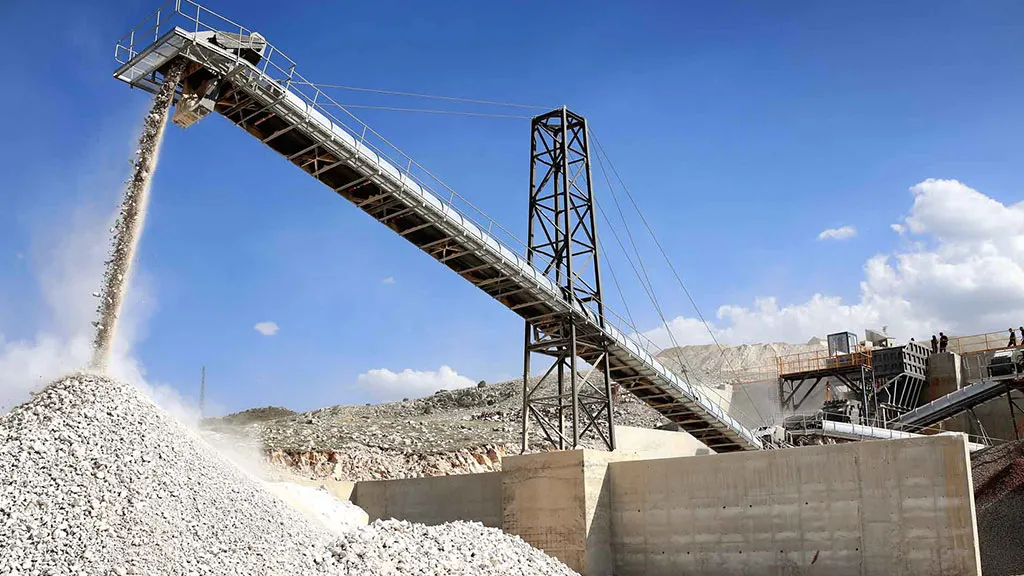
A wide variety of problems can occur while conveyors are running. The most common of these and their solution methods are explained in detail below.
- Lateral (sideways) drift of the belt
- Breakage of the take-up bearings
- Tearing of the conveyor belt
- Material spilling out, and material getting under the belt
Lateral Drift in Belt Conveyors
Every part of the conveyor rotates. As with any assembly full of moving parts, problems are frequently encountered in conveyors.
One or several of the following factors, acting together, cause the belt to drift.
The cause of the belt drift must be identified and eliminated;
- On inclined belts, the belt moves to the right and left more.
- As the distance between the carrying idlers increases, the belt drifts more to the sides.
- Return idlers not being spaced closely enough can cause drift.
- If the belt is too taut and there is little ore on it, the belt may not seat on the centre idlers, which can cause drift.
- The belt speed is high.
- The alignment of the carrying idler frames is not correct.
- The carrying or tracking idlers are not working correctly.

- The belt does not seat properly on the idlers.
- On belts operating in the open, the belt may drift under the effect of excessive wind.
- The belt scrapers do not contact the belt properly.
- Because tension will not be uniform on a low-quality belt, using such a belt causes the belt to drift.
- In the loading chute, the ore is not being fed in the direction of belt travel. The ore must be fed onto the belt centrally and in the direction of the belt.
- The belt frame is not on the axis. The shafts of one or more of the main drive, tail and snub pulleys are not perpendicular to the belt axis, and the pulley alignments have not been done correctly.
- Mud has stuck to the pulleys or idlers.
Slipping of the Belt Conveyor on the Drive Pulley
When the belt first starts moving, or when there is a load on it, if the belt slips on the drive pulley the reason is that sufficient friction force does not develop between the drive pulley surface and the belt.
To prevent slipping;
- If the drive pulley surface is not rubber-lagged, it should be rubber-lagged, and diamond-pattern grooves should be cut into the rubber.
- To increase the friction force between the belt and the main drive pulley, the belt take-up weight should be increased; if tensioning is done from the tail pulley bearings, the belt should be tensioned a little more.
- An important solution is to bring the snub pulley immediately behind the drive pulley closer to the main drive pulley, thereby increasing the wrap angle.
- The belt may have stretched; when a gravity take-up belt stretches, the weights may touch the ground. Either the belt should be shortened, or the ground beneath the weights should be deepened to keep the weights from touching the ground.
Backward Slipping of an Inclined Belt When the Belt Conveyor Is Stopped
If no precaution is taken, long inclined belts will slip backward when they stop for any reason. Especially if there is material on the belt, the backward slipping speed will gradually increase; as the ore on the belt piles up toward the tail end, ore thrown off the belt due to its acquired speed will also damage the surroundings. This is a highly undesirable situation.
There are several solutions to prevent the belt from slipping backward:
- Special locking (backstop) bearings should be used in the gearboxes.
- A disc-and-pad brake system should be installed between the gearbox and the electric motor so that the brake engages when the electric motor stops.
- In particular, a ratchet-gear (holdback) brake system should be fitted on the pulley shaft.
- Electric motors with a magnetic brake system are also used for this purpose.

- If, despite these precautions, the belt still slips backward, the system in use has lost its function. It must be replaced or repaired.
Breakage of the take-up bearings
During the conveyor tensioning process, breakage can occur if there is excessive tensioning or if the bearings bind. The bearing types generally used are of the cast type. For this reason, tensioning should be done in equal amounts and, above all, without binding.
Tearing of the Conveyor Belt
It can be seen frequently, especially at crusher outlets. Here, a chute or a slowing (dead-box) chute should be used to prevent the material from dropping onto the belt directly from the crusher outlet.
In addition, the use of an impact bar and thicker belts is recommended.
Material spilling out, and material getting under the belt
This problem is encountered on belt conveyors when side skirts (skirt seals) are not used, especially in the loading zones. Side skirts should be added to the conveyors at every loading zone.
In addition, conveyors have primary, secondary and internal scrapers. Their adjustment and wear should be monitored; otherwise they can allow material to get under the belt, which can lead both to belt tearing and to damage to the pulley.
MEKA GLOBAL