A typical aggregate crushing process follows a clear sequence:
Extraction → Primary Crushing → Secondary Crushing → Tertiary/Fine Crushing → Screening → Stockpiling
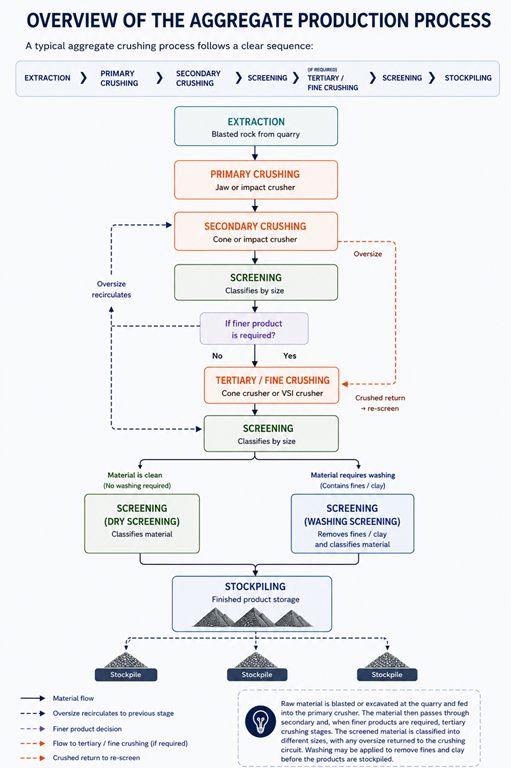
Raw material is blasted or excavated at the quarry and fed into the primary feeder. From there, the first stage of crushing plant equipment, typically a jaw or gyratory crusher, reduces the largest rocks to a size suitable for further processing. The material then passes through secondary and, when finer products are required, tertiary crushing stages to achieve the target gradation.
Vibrating screens are positioned throughout the process to classify material by particle size. Oversized material is returned to the crusher in a closed-circuit configuration, while material that already meets the required specification moves directly to the next stage or to the finished product stockpile. Belt conveyors provide continuous material transfer between crushers, screens, and storage areas, helping maintain a steady production flow.
Where feed material contains clay or where higher-quality manufactured sand is required, the process may also include washing and classification. These additional stages remove unwanted fines and improve the consistency and quality of the final aggregate products.
Evaluating Raw Aggregate Material
Every quarry is different, and the properties of the rock can vary significantly from one site to another. Before selecting any equipment or designing the process, the material must be carefully evaluated. The most important factors to consider are:
Hardness and abrasiveness. Hard, abrasive rocks such as granite, quartzite, and basalt wear crusher components quickly and favor compression crushers (jaw and cone) over impact crushers. Softer, less abrasive materials such as limestone and dolomite allow impact crushers to be used effectively.
Feed size. The maximum lump size delivered from the quarry determines the required crusher feed opening. Oversized feed causes bridging and can damage equipment.
Moisture and clay content. Wet, sticky material can blind screens and clog feeders. High clay content may require washing.
Target product gradations. The number and size of output fractions, including manufactured sand requirements, determines how many crushing stages and screening decks are needed.
Capacity requirements. Required throughput in tons per hour drives equipment sizing. Higher capacity generally means larger machines or parallel circuits rather than faster operation.
Getting these parameters right before design begins prevents costly underperformance and equipment overloading later.
Crushing Plant Design and Circuit Configuration
Two-Stage vs. Three-Stage Crushing
Most aggregate crushing plants use either two or three stages of size reduction.
A two-stage plant, typically primary jaw or impact crusher followed by a secondary impact crusher or cone crusher, suits applications where the feed is relatively soft, the top product size is not too fine, and capital cost must be minimized.
A three-stage plant adds a tertiary crusher (cone crusher or vertical shaft impact crusher) for applications requiring high proportions of fine aggregate, manufactured sand, or material that is too hard for economic reduction in two stages. Three-stage circuits produce better product shape and finer gradations at the cost of higher capital investment and greater complexity.
Open vs. Closed Circuit
In an open circuit, material passes through each crusher once. It is simpler and lower in cost but produces a wider product gradation and higher proportions of oversize.
In a closed circuit, screen oversize is recirculated back to the crusher. This narrows the product gradation, ensures consistent top size, and improves reduction efficiency. The tradeoff is higher recirculating loads and more conveying infrastructure.
Most modern aggregate plants use closed-circuit configurations at the secondary and tertiary stages, with open-circuit primary crushing.
Fine Material Bypass
Feeding crusher-run material that already contains substantial fines into every crushing stage wastes energy and increases wear. Scalping screens or grizzly feeders upstream of each crusher stage remove passing material before it enters the crusher. This single design decision can significantly reduce operating costs on high-fines feeds.
Layout and Cost Considerations
Plant layout must balance material flow efficiency against site constraints, foundation costs, and access for maintenance. Elevation differences between stages allow gravity-assisted transfer, reducing conveyor lengths. However, greater elevation change requires more civil work and structural steel. On flat sites, long horizontal conveyors are used instead.
Capital cost rises with capacity, the number of crushing stages, closed-circuit complexity, and the degree of automation. Operating cost is driven primarily by wear parts consumption, energy, and maintenance labor, all of which are influenced heavily by material hardness and the appropriateness of crusher selection.
Core Equipment of a Crushing Plant
The performance of a crushing plant depends largely on selecting the right crushing plant equipment for the material being processed and the required end products. Each machine has a specific role, and the overall efficiency of the plant is determined by how well these components work together.
Feeders
Feeders regulate the flow of material from the hopper to the primary aggregate crusher, ensuring a steady and controlled feed. Choosing the right feeder depends on the feed size, abrasiveness, moisture content, and clay content.
- Grizzly feeders combine a vibrating pan with grizzly bars that remove fines before primary crushing. Material already below the required size bypasses the crusher, while larger rock is directed into the crushing chamber. This is the most common feeder arrangement in rock quarries.
- Apron feeders use heavy-duty steel pans driven by chains and are designed to handle large, abrasive material. They are also well suited to wet, sticky feed that can cause bridging or buildup in other feeder types, making them a reliable choice for demanding operating conditions where conventional vibrating feeders would experience excessive wear.
- Wobbler feeders are well suited to wet or sticky feed. Their rotating shafts separate clay and break up material before it reaches the primary crusher, improving plant performance and reducing blockages.
- Vibrating pan feeders are commonly used in secondary and tertiary crushing circuits where the material is more uniform and less abrasive.
- Pan feeders with grizzly scalpers are typically installed where accurate feed control or additional pre-screening is required.
Together, these machines form an essential part of modern aggregate equipment, helping maintain consistent throughput while protecting downstream crushers from unnecessary wear.
Primary Crushers
The primary crusher performs the first stage of size reduction, taking large rock directly from the quarry and reducing it to a size suitable for the next crushing stage. The two most common options are jaw crushers, gyratory crushers and primary impact crushers.
Jaw crushers are the standard aggregate crusher for hard and abrasive rock. Material is compressed between a moving jaw and a fixed jaw until it fractures. Their simple design, high reliability, and ability to accept large feed sizes make them the preferred choice for granite, basalt, and other hard rock applications. MEKA's MJ Series jaw crushers are built with heavy-duty frames and optimized jaw geometry for demanding primary crushing duties.
Primary impact crushers break rock using high-speed blow bars that strike the material against breaker plates. They typically provide a higher reduction ratio and produce a more cubical product than jaw crushers, making them well suited to limestone and other less abrasive materials. MEKA's primary impact crushers include heavy-duty breaker plates and hydraulic opening systems to simplify maintenance.
Secondary and Tertiary Crushers
After primary crushing, the material passes through secondary and, where necessary, tertiary crushing to reach the required product size and shape.
Cone crushers are the preferred choice for hard and abrasive rock. Material is compressed between a rotating mantle and a stationary concave, producing consistently graded aggregate with excellent particle shape. MEKA's MCH Cone Crushers feature hydraulic setting adjustment, overload protection, and multiple chamber options for different production requirements.
Secondary and tertiary impact crushers (HSI) continue the crushing process by using impact rather than compression. They are commonly selected for limestone and other medium-hard materials where both additional size reduction and improved particle shape are required. MEKA's MSI secondary impact crushers use a four-blow-bar rotor, hydraulically adjustable breaker plates, and replaceable wear liners for reliable long-term operation.
Vertical shaft impact (VSI) crushers are generally used in the final crushing stage. Rock is accelerated through a high-speed rotor and crushed by impacting either a rock bed (rock-on-rock) or steel anvils (rock-on-steel). VSI crushers are widely used to produce manufactured sand and improve particle shape by reducing flat and elongated particles. MEKA offers G Model VSI crushers for rock-on-rock applications and L Model machines for rock-on-steel configurations, providing solutions for granite, basalt, limestone, and recycled materials.
Selecting the right combination of crushers is one of the most important decisions when designing aggregate equipment. The type of aggregate crusher used at each stage directly affects production capacity, wear costs, energy consumption, and the quality of the final product.
Hammer crushers are a single-stage solution for very soft materials where high reduction ratios are needed but abrasion resistance is not a concern, commonly used in cement raw material preparation.
Screens
Vibrating screens classify crushed material by size between and after crushing stages. Screen type selection depends on material, moisture content, and the classification task:
Inclined screens are the industry standard for dry aggregate classification. MEKA's MS inclined screens feature a high-capacity, high-efficiency design with long service life under demanding conditions.
Horizontal screens offer a more compact footprint and are suited to applications requiring precise separation with lower headroom. MEKA's MHS series horizontal screens are designed for reliability under the most demanding applications.
Grizzly screens handle the coarsest, heaviest feeds, typically between primary and secondary crushing, with a two-deck circular vibration design for efficient classification of both coarse and fine fractions on a single body.
Scalping screens are commonly installed before the primary crusher to remove fines and undersized material from the feed, allowing the crusher to focus on processing larger rock fragments. By reducing unnecessary load and preventing excessive fines from entering the crushing chamber, they help improve crusher performance and overall plant efficiency.
Dewatering screens are used in wet processing circuits to remove excess moisture from washed aggregate and manufactured sand, delivering a low-moisture product for stockpiling.
Belt Conveyors
Belt conveyors transfer crushed and screened material between equipment and to final stockpiles. They are the circulatory system of a crushing plant. Conveyor width, speed, angle, and belt specification must be matched to material flow rates and the characteristics of the material being handled.
Wet Processing
When aggregate requires higher cleanliness levels or manufactured sand needs tighter control of fines and clay content, wet processing equipment is added after the crushing circuit.
Fine material washers clean and classify sand-sized particles, while coarse material washers remove unwanted contaminants from crushed stone. For heavily contaminated feed with high clay content, log washers provide additional scrubbing action. Compact sand plants combine classification and dewatering in a space-efficient solution.
MEKA's washing solutions are designed to work together with crushing and screening plants, providing effective cleaning and classification for different aggregate applications. More information about washing equipment is available at MEKA Washing Equipment.
Plant Operation and Optimization
Throughput and Capacity Management
Actual plant throughput is always lower than the theoretical capacity of the largest machine in the circuit. Bottlenecks, usually at screens or at the crusher with the lowest reduction ratio, limit the total output. Operators must monitor feed rates, crusher settings, and screen efficiency continuously to identify and address constraints.
Recirculating load in closed circuits must be managed: excessively high recirculation indicates crusher settings or screen apertures need adjustment.
Wear Parts Management
Crusher wear parts, jaw plates, blow bars, mantle and concave bowl, VSI rotor tips, consume steadily and require regular inspection and timely replacement. Allowing wear parts to run past their useful life increases energy consumption, reduces product quality, and risks catastrophic failure. Planned wear part changes based on tonnage processed (not just calendar time) reduce unplanned downtime.
Energy Consumption
Power consumption is one of the largest operating costs in a crushing plant, typically ranking just behind wear parts. In hard and abrasive rock applications, energy costs can even exceed wear-related expenses. Crusher selection and operating conditions have a direct impact on specific energy consumption (kWh per tonne). For example, a properly sized cone crusher operating with a consistent choke feed and the correct closed-side setting will generally consume less energy than the same crusher running with an unstable feed or an unnecessarily wide CSS.
Using a crusher below its required capacity is one of the most common causes of energy inefficiency. When a crusher is undersized for the application, it often operates at near full load, experiences increased liner wear, and still struggles to achieve the required production rate.
Several practical measures can significantly improve energy efficiency. Maintaining a steady choke feed helps compression crushers operate closer to their optimal performance range. Scalping and bypass screening prevent material that already meets the required size from being crushed again, reducing unnecessary energy consumption. Properly sizing conveyors, screens, and drive systems is also important; selecting equipment larger than required does not always provide a real advantage.
Variable frequency drives (VFDs) can help control load fluctuations on feeders and screens, but they cannot compensate for an incorrectly designed crushing circuit. No control system can recover the energy lost from processing the same material multiple times. In a 300–400 t/h two-stage crushing plant, the difference between a well-balanced circuit and a poorly matched one can represent a significant power difference over continuous operation.
Maintenance
Scheduled preventive maintenance, lubrication, bolt torque checks, bearing condition monitoring, belt inspection, screen media replacement, is the single most effective way to maximize plant availability. Many operators overlook the critical path: a conveyor idler failure that halts production for four hours costs far more than the bearing itself.
Automation
Modern aggregate crushing plants benefit significantly from automation: automated feed rate control, crusher load optimization, remote monitoring, and plant-wide SCADA systems reduce the dependence on operator skill and prevent the damage caused by overloading. MEKA offers plant automation systems that integrate all equipment in the circuit into a single control interface.
Dust and Environmental Management
Dust suppression, water sprays, enclosed transfer points, dust extraction, is both an environmental requirement and a health protection measure. Proper management also reduces wear on equipment caused by fine abrasive particles in bearings and drives.
Safety Considerations
Crushing plants combine several common industrial hazards in a single operating environment, including rotating equipment, elevated platforms, dust, noise, and the movement of large volumes of rock. While standard safety measures are well established, some risks require continuous attention during daily operations.
Machine guarding around drive belts, couplings, and conveyor pulleys is a fundamental requirement. However, many serious incidents are related to stored material and confined spaces. Hoppers, bins, and silos can develop material bridges, where rock or aggregate forms a stable structure above an empty space. Entering these areas to remove blockages is extremely dangerous, as the material can collapse without warning. Blocked material should always be cleared using safe methods from outside the equipment, with appropriate tools or remote systems.
Lockout-tagout (LOTO) procedures must be followed before any person enters a crusher chamber. Although access may sometimes be required for inspections or removing trapped material, these situations should be treated with the same level of control as planned maintenance. All energy sources must be isolated, moving components secured, and entry procedures strictly followed.
Common Crushing Plant Problems
Most of the problems that shut a plant down or quietly eat into tonnage trace back to a handful of recurring causes:
Crusher plugging or choking, usually feed related: oversized lumps bridging in the chamber, moisture and clay causing material to pack rather than flow, or a closed-side setting that's crept open from worn liners. Check the CSS and feed gradation before assuming the crusher itself is undersized.
Screen blinding, near-size, wet, or sticky material sticks in the apertures instead of passing through. Common on clay-bearing feeds in wet weather. Polyurethane media, correct spray water placement, and a steeper deck angle usually help more than adding screen area.
Excessive recirculating load, if the closed circuit keeps sending more material back to the crusher than expected, the usual culprits are worn liners that have opened the CSS beyond spec, or a screen deck that's lost efficiency (torn media, bound apertures). This shows up as declining tonnage well before anyone notices the liners are worn.
Belt mistracking, conveyors running off-center wear belt edges and structure and eventually cause spillage or a torn belt. Almost always traceable to a fouled or misaligned idler, not the belt itself; chasing the belt without checking idler alignment wastes time.
Premature wear part failure, often a mismatch between the crusher type and the actual rock, not a manufacturing defect. An impact crusher run on abrasive granite eats blow bars far faster than the catalog life suggests; that's a material selection issue, not a warranty issue.
Tramp metal damage, rebar, excavator teeth, or bucket fragments entering the primary crusher can crack jaw plates or damage impact rotors. A metal detector ahead of the primary, with a reliable reject mechanism, pays for itself the first time it catches something.
Most of these show up as a slow decline in tonnage rather than a sudden failure, which is exactly why they get missed. Nobody notices until the shortfall has been going on for weeks.
Stationary vs. Mobile Crushing Plants
Stationary plants are the choice for high-volume, long-life quarries. They offer the lowest operating cost per tonne, the highest throughput capacity, and the greatest flexibility in circuit design. Civil works, electrical infrastructure, and installation cost are higher, and the plant cannot be relocated easily.
Mobile (portable) plants trade some of those advantages for rapid deployment and the ability to move between sites. Wheel-mounted portable plants can be transported by road and set up in hours rather than months. They are ideal for contractors who move between projects, for quarries with shorter reserve lives, or for applications like construction and demolition waste recycling where the material is at the point of use. For a detailed selection guide, see MEKA’s Mobile Crushing & Screening Plants guide.
MEKA offers both complete stationary plant solutions and a comprehensive range of portable crushing and screening plants, including portable jaw crushers, portable impact crushers (primary and secondary), portable cone crushers, portable VSI crushers, portable screens, and portable two-stage plants, allowing the right configuration for every project type and budget.
MEKA Crushing and Screening Equipment
MEKA has been manufacturing a large scale of aggregate crushing equipment and has installed plants in more than 110 countries. Backed by a dedicated R&D team of 70 engineers and 5 manufacturing facilities equipped with robotic welding and precision metalworking, MEKA's product range covers every component in an aggregate crushing plant:
Feeders: Grizzly Feeder, Apron Feeder, Wobbler Feeder, Vibrating Feeder, Pan Feeder with Grizzly Scalper, Belt Feeder
Crushers: Jaw Crusher, Primary Impact Crusher, Secondary Impact Crusher, Tertiary Impact Crusher, Cone Crusher, Vertical Shaft Impact Crusher – G Model, Vertical Shaft Impact Crusher – L Model, Hammer Crusher
Screens: Inclined Screen, Horizontal Screen, Grizzly Screen, Scalping Screen, Dewatering Screen
Wet Processing: Fine Material Washers, Coarse Material Washer, Log Washer, Compact Sand Plants
Mobile Solutions: Portable Jaw Crushers, Portable Primary Impact Crushers, Portable Secondary Impact Crushers, Portable Cone Crushers, Portable VSI Crushers, Portable Screens, Portable Wash Plants, Portable Two-Stage Plants
Plant Infrastructure: Belt Conveyors, Plant Automation Systems
Recycling Technologies: Construction and Demolition Waste Recycling, Slag Recycling for Metal Recovery, Ceramic Waste Recycling, Quarry Waste Recycling
All equipment is supported by MEKA's after-sales service network and spare parts supply, ensuring that production disruptions are resolved quickly wherever a plant is located.
Explore MEKA Crushing and Screening Equipment →
Request a Quote for Your Crushing Plant Project →