What Is a Concrete Pump? Types and Areas of Use
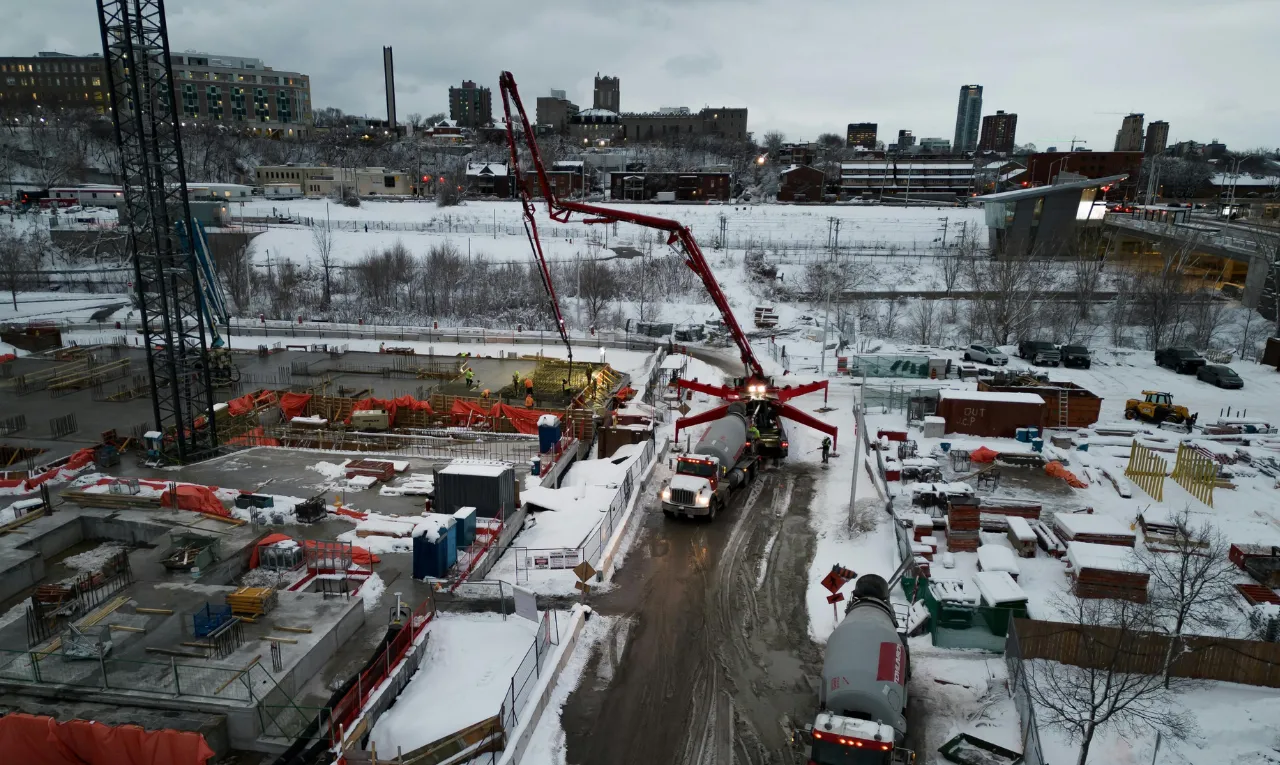
The concrete pump is one of the indispensable pieces of equipment in modern construction projects in terms of speed, quality and occupational safety. Especially in high-rise buildings and large infrastructure projects, it ensures that concrete is conveyed continuously and in a controlled manner. Depending on the scale of the project and the site conditions, different solutions such as a stationary concrete pump or a mobile concrete pump can be preferred. The right pump choice provides both time and cost advantages while significantly reducing the labour burden.
What Is a Concrete Pump and What Does It Do?
A concrete pump is a machine that takes fresh concrete from the mixer and conveys it under pressure to the pouring point through a pipeline. It is much faster and easier to control than traditional methods (wheelbarrow, bucket, crane). In many applications, from tall buildings to wide foundations, it provides continuous flow to hard-to-reach places, shortens the time and reduces the number of workers.
How Does a Concrete Pump Work?
The basic idea relies on a powerful hydraulic circuit. The mixer empties the concrete into a hopper, and the agitator paddles in the hopper prevent the concrete from segregating. The most common system, twin-piston pumps with an S-valve, works as follows:
- Suction stroke:As the concrete is drawn into the cylinder, one piston retracts; the S-valve opens the inlet of that cylinder.
- Delivery stroke:The other piston pushes the concrete that filled during the previous cycle through the S-valve into the pipeline.
Thanks to this sequential movement, a continuous flow is obtained. The concrete is conveyed to the pouring point through steel pipes and/or flexible hoses.
What Are the Types of Concrete Pumps?
1) Stationary (line) concrete pump
It is mounted on a trailer or chassis and placed on the site. With high pressure and a high flow rate, it is best for long lines and large projects. It is effective in works such as high-rise buildings, dams, tunnels and industrial plants.
2) Mobile (boom) concrete pump
It has a foldable boom (arm) on a truck chassis. It is easy to set up and, with different boom lengths, provides flexible reach. It is ideal for sites that require rapid mobilization, such as housing, commercial buildings, bridges and viaducts.
3) Small (mini) concrete pump
Compact dimensions, access to narrow spaces and easy manoeuvring. It is an economical solution for small to medium-sized jobs such as urban renovations, landscaping works and indoor work.
4) Ground (line) type / trailer pump
It has no boom; it is connected to a separate pipeline. It is used for very long vertical and horizontal distances, as well as in special applications such as shotcrete and screed.
Concrete Pump Technical Specifications and Dimensions
How Far Does It Reach?- Mobile pumps:Reach depends on the vertical/horizontal capacity of the boom; typical range ~20–70 m boom length.
- Line or stationary pumps:Range depends on the pipeline installed and the pressure capacity. With the right mix, the right pipe diameter and a low-loss line layout, it is possible to reach hundreds of metres vertically and kilometres horizontally. The actual value varies depending on the viscosity of the mix, the number of bends and the amount of friction in the line.
Instead of asking "how many tonnes does it carry?", use the right metrics. A concrete pump is measured in terms of flow rate (m³/hour) and maximum line pressure (bar).
- Mini class:~20–30 m³/h
- Typical mobile:~70–120 m³/h
- High-capacity stationary:~150–200 m³/h. Values vary depending on the manufacturer and model.
Other important factors
- Pipe/line diameter: most often 100 mm or 125 mm
- The maximum aggregate size should be selected according to the line size and the number of bends.
- Hydraulic power and efficiency
- The consistency (slump) of the concrete determines its pumpability.
In Which Areas Are Concrete Pumps Used?
- Housing and commercial buildings:tall buildings, shopping centres and offices
- Infrastructure:bridges, viaducts, motorways, metros and tunnels
- Industrial plants:factories, power plants, refineries
- Water structures:dams and hydroelectric power plants
- Foundations and ground:raft foundations, pile filling, screed, shotcrete
What to Consider When Choosing a Concrete Pump
- Project size and daily pouring plan:The total area and the targeted daily m³ determine the required flow rate.
- Pouring distance and height:It determines the boom length on a mobile pump, and the pressure and line design on a stationary/line pump.
- Site access and setup area:narrow roads, weak ground, obstacles... influence the decision between a mobile, mini or stationary pump.
- The concrete mix must be pumpable;the slump, aggregate grading and admixtures must be suitable for the pipe diameter.
- Safety and workflow:the placement of the outriggers, control of the hose tip, the communication plan, wind and traffic.
Practical Notes for Concrete Pump Operation and Maintenance
- Set up the pipeline as straight, short and with as few bends as possible. If you must use bends, prefer wide-radius ones.
- Use lubricating grout (priming) at the first fill and after stops; this helps reduce segregation and blockage.
- Make sure there is a qualified operator at the end of the hose, and keep a safe distance from sudden pressure changes.
- Carry out scheduled maintenance for the filters, oil and wear parts (S-valve, wear plate, piston seals).
- When working in hot or windy weather, follow the manufacturer's instructions.
Conclusion
A concrete pump selected in the right type and capacity sets the pace of the site. If you make sure you understand your needs and design the line correctly, you can keep both quality and schedule under control. Here, MEKA Global can help you simplify your processes by offering pump solutions tailored to the needs of different projects and providing engineering support.
MEKA GLOBAL