Feeder Design and Selection for Crushing and Screening Plants

In crushing and screening plants, feeders are generally used to feed the crusher in front of them evenly, at a set capacity and without trouble. That crusher may be the primary crusher, which first crushes the material obtained from the quarry by drilling and blasting, or a secondary or tertiary crusher at the second and third stages.
Feeders that feed primary crushers are heavy-duty units with a hopper of highly rigid construction. We call these feeders main feeders or primary feeders.
This guide covers the types of feeder used in crushing and screening plants, where each one belongs and which variables set feeder capacity.
What a Feeder Does in a Crushing Plant
Even feeding at a set capacity. Crusher feeder equipment is there to feed the crusher evenly, at a set capacity and without trouble.
In crushing and screening plants, hopper feeders are generally used so that secondary and tertiary crushers are fed continuously, evenly and at the same capacity. These crushers do not perform as required when they are not fed evenly. For example, when a cone crusher is not fed evenly and its crushing chamber is not full, wear increases considerably and bearing life shortens because of unbalanced loading. In a vertical shaft impactor (VSI), the rock box does not form and crushing performance drops considerably.
Withstanding impact at the dump point. Primary feeders must withstand the impact of material dumped from trucks.
Keeping fines and clay out of the primary crusher. On a vibrating grizzly feeder, the grizzly screening section at the front of the feeder bypasses fine and dirty material so that it does not enter the crusher. The scalping section below explains why.
Six Types of Feeders: Primary Feeders and Hopper Feeders
Depending on the physical properties, size distribution, contamination and moisture content of the material coming from the quarry, primary feeders can be vibrating grizzly feeders; vibrating feeder–grizzly or roller screen groups; apron feeders; apron feeder–grizzly or roller screen groups; reciprocating feeders; or reciprocating feeder–grizzly or roller screen groups.
Secondary and tertiary crushers are fed by feeders placed under a hopper of a given volume. Compared with primary feeders, these are relatively medium- or light-duty units, and we usually call them hopper feeders. They can be vibrating feeders, belt feeders, or medium- or light-duty apron feeders.
The six types of feeders below follow these two groups: primary feeders first, then hopper feeders.
Where a grizzly feeder belongs
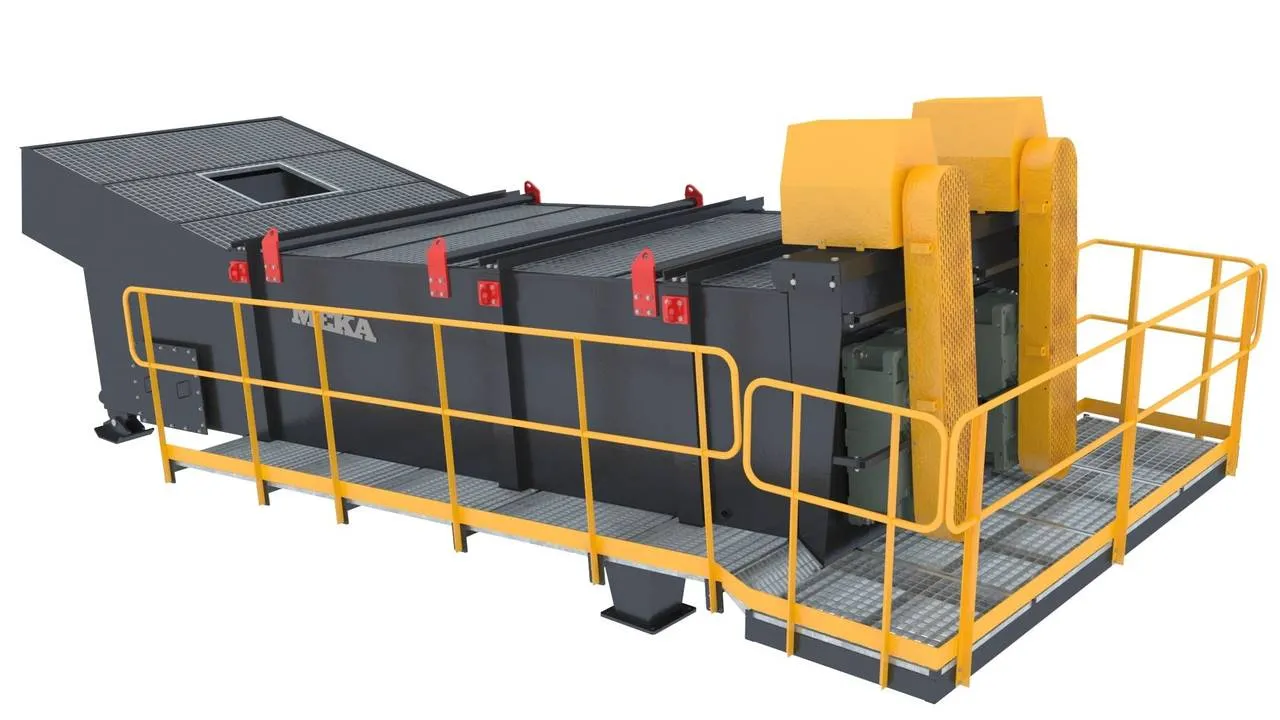
Vibrating grizzly feeders are generally used to feed run-of-mine (ROM) material obtained by blasting to the primary crusher in front of them. The grizzly screening section at the front of the feeder, with one or more steps, bypasses fine and dirty material so that it does not enter the crusher.

Pan feeders with a grizzly scalper
In some cases, the feeder and grizzly sections are separated and built as separate units, to screen out the fines in the feed more efficiently than a vibrating grizzly feeder does, raising crusher performance and reducing wear costs. Driving the grizzly screen independently of the feeder lets variables such as the throw angle, vibration amplitude and angular velocity be set independently of the feeder, so screening becomes more efficient. The grizzly section should have at least two steps, so that the material drops and turns as it passes from one step to the next, and clay and other foreign material stuck to it separates and goes to the bypass line.


Heavy-duty apron feeders at the primary crusher
In crushing and screening plants, apron feeders that feed primary crushers in particular are heavy-duty feeders. Their main elements are the same as those of the crawler undercarriages of the dozers and excavators widely used in the industry: chain, carrier and return rollers, drive sprockets, tail wheels, apron pans, impact rails, main frame and skirts. These elements need no lubrication or much maintenance, and their wear is minimal. Optionally, a spillage conveyor can be placed under the feeder to collect and remove material that sticks to the pans and falls on the return side.


When a reciprocating feeder suits clayey, sticky material
The reciprocating feeder is a feeder type used for ROM material that is sticky, with high clay and moisture content. In particular, reciprocating feeders are used as heavy-duty mining feeders. The carriage moves back and forth on closely spaced rollers, mostly with a hydraulic cylinder. On the forward movement, material dumped into the hopper fills the trough; on the return movement, material in proportion to the travel is discharged to the equipment ahead of the feeder. The back-and-forth travel of the carriage (stroke) is controlled by the stroke of the hydraulic cylinder and sensors placed at suitable positions.

Vibrating feeders under the hopper
Under-hopper vibrating feeders are generally used so that secondary and tertiary crushers are fed continuously, evenly and at the same capacity. These feeders are usually placed under a hopper of 10–20 m³. The feeder body is either suspended from the hopper together with coil springs, or sits on a fixed frame together with coil springs.

When a belt feeder fits, and when it does not
Belt feeders are generally used to feed material of limited size stored in hoppers. Large and abrasive materials are not suitable for belt feeders, because they can easily damage the belt top cover. The maximum material size for belt feeders is around 100 mm. The damage that abrasive, sharp-edged material does to the belt top cover can be offset to a certain extent by making the cover thicker.


Five Questions Before You Choose a Feeder
Each question below points to one or more of the types above.
1. How large are the largest lumps?
The ROM material that vibrating grizzly feeders feed to the primary crusher can have a maximum lump size of up to 1500 mm.
For apron feeders, reference values for the average and maximum lump size that can be fed depend on the width between the skirts: from 76 mm average and 152 mm maximum at 457 mm between the skirts, to 457 mm average and 914 mm maximum at 1829 mm.
For belt feeders, the maximum material size is around 100 mm.
2. How wet and clayey is the material?
The reciprocating feeder is used for ROM material that is sticky, with high clay and moisture content.
With a vibrating grizzly feeder, clay and similar material in the ROM feed is bypassed so that it leaves the plant before entering the crusher. In the material travel speed calculation for vibrating grizzly feeders, the moisture and contamination coefficient is taken as 1 for dry material, 0.8 for moist material and 0.6 for moist and clayey material.
3. How abrasive is the material?
If the material is abrasive, the necessary measures against wear must be taken both in the hopper and in the body of a vibrating grizzly feeder.
Large and abrasive materials are not suitable for belt feeders; the damage to the belt top cover can be offset only to a certain extent by a thicker cover.
On heavy-duty apron feeders, the undercarriage-type main elements need no lubrication or much maintenance, and their wear is minimal.
4. What capacity does the crusher need?
Depending on the size of the primary crusher they feed, the feed capacity of vibrating grizzly feeders can reach 1500 t/h, and the feeder must be able to deliver that capacity.
Under-hopper feeders are generally used so that secondary and tertiary crushers are fed continuously, evenly and at the same capacity.
5. Where does the feeder sit in the flow sheet?
Primary crushers are fed by primary feeders: vibrating grizzly, apron or reciprocating feeders, alone or in groups with a grizzly or roller screen. Secondary and tertiary crushers are fed by hopper feeders placed under a hopper: vibrating, belt, or medium- or light-duty apron feeders.
Sizing: What Actually Determines Feeder Capacity
Capacity is calculated differently for each feeder type. The full calculations are in the separate guides for vibrating, apron, belt and reciprocating feeders.
Vibrating grizzly feeders
Qv = 3600 · v · B · H
- Qv: volumetric capacity, m³/h
- v: actual material travel speed, m/s
- B: inner width of the feeder, m
- H: bed depth at the feeder discharge, m
H is taken from experience: H ≤ 0.2 B for sand and fine gravel, H ≤ 0.3 B for ROM material up to 150 mm, and H ≤ 0.5 B for material larger than 150 mm.
The actual material travel speed v depends on the vibration amplitude along the line of vibration, the angular velocity, the throw angle and the throw number, together with a slope factor, a material size factor and a moisture and contamination coefficient.
The exciter speed n is selected between 650 and 1000 rpm, depending on the type of exciter mechanism used. The throw angle is selected between 35° and 55°; 35° is the most widely applied. Throw numbers of 2.5–3.5 are suitable for vibrating grizzly feeders.
The slope factor is taken as 1.15 at a trough slope of 3°, 1.3 at 5°, 1.48 at 8° and 1.6 at 10°. Based on experience, the material size factor is taken as 1 for sand, 0.8–0.9 for material up to 150 mm and 0.6 for material larger than 150 mm.
Apron feeders
Q = 3600 · B · d · v · δ · φ · c
- Q: capacity, t/h
- B: width between the feeder skirts, m
- d: bed depth of the conveyed material on the feeder, m
- v: feeder speed, m/s
- δ: bulk density of the material, t/m³
- φ: fill factor, 0.75–0.80
- c: coefficient depending on the feeder inclination, c = (100 − β) / 100, where β is the angle of the feeder to the horizontal
Belt feeders
Q = 3600 · w · d · v · δ
- Q: capacity, t/h
- w: width between the hopper skirts, m
- d: bed depth on the belt at the hopper outlet, m
- v: belt speed, m/s
- δ: bulk density of the material, t/m³
The choice of feeder speed depends on the size distribution and abrasiveness of the material and on the design of the hopper feed zone. Depending on these properties, it can be selected between 0.08 m/s and 0.5 m/s; 0.25–0.35 m/s is the belt feeder speed range used most in crushing and screening plants.
Scalping Before the Primary Crusher
In primary crushers, material smaller than the set crusher discharge opening entering the crusher is generally not desired, because of crusher performance. It is also desired that clay and similar material in the ROM feed is bypassed and leaves the plant before entering the crusher.
That is why the grizzly screening section at the front of a vibrating grizzly feeder, with one or more steps, bypasses the unwanted fine and dirty material so that it does not enter the crusher. In this role, the vibrating grizzly feeder works as a scalping feeder.
Grizzly feeder design and scalping are covered in detail in a separate guide.
The Hopper and the Feed Point
In crusher hopper design, each value below belongs to a specific feeder type.
Vibrating grizzly feeder. ROM material can be brought to the feeder hopper by dump trucks with capacities of up to 50 m³, so the hoppers of these feeders must have a high capacity. Feeder bodies and supporting frames must also withstand the high impact loads that large lumps create during dumping.
Under-hopper vibrating feeder. These feeders are usually placed under a hopper of 10–20 m³.
Apron feeder. In closed hoppers, the bed depth d on the feeder is set by the height of the hopper outlet opening, that is, the gate height; if this height is H, d ≅ 0.75 H. In open hoppers, it is set by the width between the hopper skirts according to the maximum lump size; for ROM feeds with a maximum lump size of 600–1000 mm, d ≅ (0.5–0.7) B can be used.
Belt feeder. The width w between the hopper skirts must not be less than the following values, depending on the maximum lump size bmax of the material fed.
| Material | Hopper height | Minimum width w |
|---|---|---|
| Low abrasiveness | Limited | w = 3.40 × bmax |
| Low abrasiveness | Large | w = 4.25 × bmax |
| Highly abrasive | Limited | w = 4.50 × bmax |
| Highly abrasive | Large | w = 5.0 × bmax |
Table 1. Minimum width between hopper skirts for belt feeders

Frequently Asked Questions
Which feeder type is used for wet, clayey material?
The reciprocating feeder is a feeder type used for run-of-mine material that is sticky, with high clay and moisture content. Its carriage moves back and forth on closely spaced rollers, mostly with a hydraulic cylinder, and discharges material in proportion to its travel to the equipment ahead. In particular, it is used as a heavy-duty mining feeder.
How is feeder capacity calculated?
It depends on the feeder type. For a vibrating grizzly feeder, Qv = 3600 · v · B · H; for an apron feeder, Q = 3600 · B · d · v · δ · φ · c; for a belt feeder, Q = 3600 · w · d · v · δ. Each variable is explained in the sizing section above.
What is the difference between a grizzly feeder and a grizzly screen?
A vibrating grizzly feeder feeds and screens in one unit. In a vibrating feeder–grizzly screen group, the feeder and grizzly sections are separate units. Driving the grizzly screen independently lets its throw angle, vibration amplitude and angular velocity be set independently of the feeder, so screening becomes more efficient. The aim is to screen out fines more efficiently, raising crusher performance and reducing wear costs.
Which feeders work under a hopper?
Under-hopper vibrating feeders are usually placed under a hopper of 10–20 m³ and are used so that secondary and tertiary crushers are fed continuously, evenly and at the same capacity. Belt feeders are used to feed material of limited size stored in hoppers, with a maximum size of around 100 mm; large and abrasive materials are not suitable for them because they can easily damage the belt top cover.
MEKA GLOBAL