Optimization with Modal Analysis in the Design of Vibrating Screens and Feeders
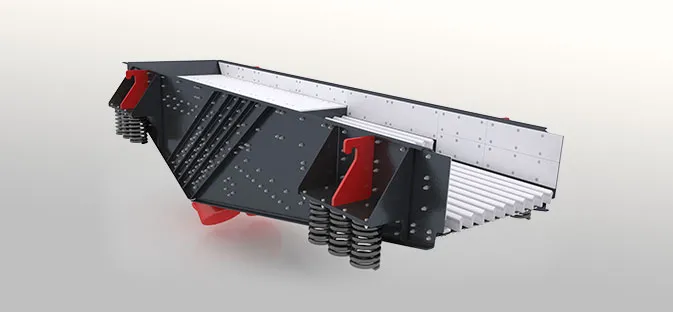
Vibrating Screens and feeders have great importance in material handling and processing operations in sectors such as mining, aggregate and recycling. The dynamic behaviour of this equipment is closely related to its efficiency, durability and overall performance, and thus to the process performance. For this reason, one of the fundamental tools used to develop and optimize the designs of vibrating screens and feeders is modal analysis.

In this article, while addressing the principles, methodologies and applications of modal analysis, the focus is especially on the mathematical modelling aspect of these important machines in the design context, the theory of natural frequency, modal analysis theory, the equations of motion and experimental modal analysis measurement methods. In addition, by emphasizing the importance of resonance theory, we will focus on how we can relate the phenomenon of resonance to other topics.
Natural Frequency and Its Theory
In the field of quantum mechanics, the concept of natural frequency extends down to atoms, the fundamental building blocks of matter. The concept of natural frequency is closely related to the vibration behaviour of atoms within molecules; this phenomenon forms the basis of various chemical and physical processes.
To understand modal analysis better, one must first understand the phenomenon of natural frequency and resonance. Natural frequency represents a system's ability to vibrate on its own when subjected to an external force. It is the lowest frequency in the vibration of a system or structural component. Determining the natural frequency is a critical step in understanding the vibration behaviour of the system. Resonance can occur at the natural frequency, which means that the vibration in the system will increase. For this reason, natural frequencies must be taken into account at the design stage, and design changes must be made to prevent unwanted resonances.

Resonance occurs when a system's natural frequency is close to the operating frequency of an external excitation. In this case, the vibration amplitude of the system increases greatly. In vibrating screens and feeders, the phenomenon of resonance can lead to serious problems. Modal analysis helps prevent resonance by identifying the natural frequencies of the system at the design stage. For this reason, accurately predicting and analysing the natural frequencies is critically important.
The Basic Principles of Modal Analysis
Modal analysis theory aims to understand the vibration behaviour of structures through mathematical and physical principles. This theory aims to determine the vibration modes of a system and the frequencies belonging to these modes by analytical and experimental methods. In this way, important information is provided toward goals such as detecting structural problems, making design improvements and controlling vibration.
This type of analysis characterizes the vibration behaviour by determining the natural frequencies, mode shapes and damping ratios of the system. These parameters provide fundamental information about the vibration behaviour of the equipment, helping to identify potential problems at the design stage and to improve the design. Modal analysis determines the mode shapes by understanding how the system responds to external excitations.

For a better understanding of the method, it will be useful to give some formulations related to how the modal properties of a linear system can be obtained. When an undamped linear system with multiple degrees of freedom is considered, the equation of motion can be written as follows.
[M] {x″(t)} + [K] {x(t)} = {f(t)} (1.1)
Here, the matrices [M] and [K] are the mass and stiffness matrices respectively, and the vectors {f} and {x} are the force and displacement vectors.
By assuming {f(t)} = 0, the free-vibration solution can be carried out. In this case, the existence of a solution as follows can be assumed.
{x(t)} = {X} e^(iωt) (1.2)
When the variables are substituted, equation (1.1) takes the form
([K] − ω²[M]) {X} e^(iωt) = {0} (1.3)
[M]⁻¹ [K] {X} = λ {X}; λ = ω² (ω: natural frequency)
.
From the solution of the standard eigenvalue problem given in equation (1.3), the natural frequencies and mode shapes can be found.
Modal Analysis Using the Finite Element Analysis (FEA) Method
Finite Element Analysis (FEA) is a technique frequently used in modal analysis. FEA simulates the dynamic behaviour of complex structures using mathematical modelling. In the context of vibrating screens and feeders, FEA divides the equipment into finite elements, each of which represents a small part of the structure. These elements are joined at nodes, forming a mesh that approximately mimics the real structure.

The equations of motion, as with Newton's second law, are converted into a system of algebraic equations that describe the behaviour of each finite element. These equations are solved to predict the vibration modes, natural frequencies and mode shapes of the structure. By examining the results obtained, the critical modes that could lead to resonance or structural weaknesses can be identified.

In modal analysis carried out with the Finite Element method, the mass and stiffness matrices are calculated for the finite elements. The stiffness matrix includes the geometry, material properties and connections of the element. The mass matrix represents the mass of the element. These matrices are used to analyse the dynamic behaviour of the system.
[M] {x″(t)} + [K] {x(t)} = {f(t)} (1.1)
The sum of the mass and stiffness matrices of all the finite elements forms the stiffness and mass matrices of the system. These matrices are used to calculate the natural frequencies and vibration modes.
From the solution of the standard eigenvalue problem given in equation (1.3), the natural frequencies and mode shapes are found.

Experimental Modal Analysis Methods
In the design of vibrating screens and feeders, modal analysis can also be carried out with experimental and computational approaches. Experimental modal analysis excites the equipment with controllable inputs (for example, impact hammers or vibration devices) and measures its response through strategically placed sensors. The data obtained is then processed using techniques such as the Fast Fourier Transform (FFT) to obtain the natural frequencies and other modal parameters.

Modal analysis is used intensively in various industries to analyse and verify the designs of, for example, aircraft chassis parts, wind- or gas-turbine blades, car chassis, and anything else that is subjected to forces and may have critically low-damped resonance frequencies.
Critically low-damped resonance frequencies will react strongly and vibrate even from very small amounts of applied force and energy.
Modal analysis can give the user a general impression of the object's natural frequencies, damping parameters and structural mode shapes. In this way, the user can modify the object so that it is less sensitive to the applied forces — for example, they can optimize the object's design according to shape and mass.

Using the damping properties found in the modal test, Finite Element analytical models can be correlated with real-life prototypes.
Experimental modal analysis is a method used to determine the vibration behaviour of a structure. In this method, vibration data is obtained using vibration sensors placed at different points of the structure. This data is analysed to determine the natural frequencies, mode shapes and damping ratios of the structure. Experimental modal analysis methods are an important method used to obtain results close to real operating conditions. In the future, it is expected that the method will be developed to offer more effective solutions.
Design Optimization Examples
Structural Improvement
Modal analysis is used to detect potential resonance problems, which enables designers to improve structural integrity. By identifying the dominant modes that cause resonance, it becomes possible to prevent resonance through design changes in critical elements and to improve the overall operating conditions.
Vibration Reduction
Modal analysis can also be used to minimize the excessive vibrations produced by vibrating machines. By determining the critical frequencies, it provides designers with solutions for new damping methods and vibration-isolation systems.
Performance Improvement
Designs made within the framework of modal analysis help to keep the critical frequencies outside the operating speed. This prevents the occurrence of resonance during operation that could cause excessive vibrations, premature wear and a reduction in equipment life. In addition, it sheds light on the creation of solutions that will increase the efficiency of the screening and feeding operation at the operating frequency.
Predictive Maintenance and Reliability Assessment
By examining the modal values of prototypes and existing vibrating equipment, these aspects are used for reliability and durability assessment. A deviation that may occur in the expected modal values can be used to detect defects in the design or in the process.
Challenges and Methods to Be Developed
Although the Finite Element Method is a powerful tool, it is important that the analysis boundary conditions, material properties and contacts are modelled appropriately. Advances in computation and simulation techniques, by continuously addressing the problems in question, make it possible for the Finite Element Method to give more consistent results.
In the future, developments in sensor technology and the advancement of numerical analysis methods may contribute to solving the challenges in question. The integration of modal analysis with real-time monitoring and predictive maintenance applications may contribute to improving machine reliability and performance.
Conclusion
Modal analysis methods stand as an important tool to be used in the design and improvement of vibrating equipment. The combined-solution approach of experimental and computational modal analysis methods makes it possible to make design changes, increase performance, put a stop to existing problems and, as a result, design more reliable machines for aggregate handling and processing systems. Along with the developing technique, the integration of modal analysis and numerical modelling will continue to contribute to the development of new designs for vibrating machines. The phenomenon of resonance is an important consideration in the design and operation of vibrating machines; by working in coordination with modal analysis methods, new contributions will be offered to keep the resonance phenomenon from being an unwanted surprise for designers.
References
https://en.wikipedia.org/wiki/Molecular_vibration
https://community.sw.siemens.com/s/article/Natural-Frequency-and-Resonance
https://makina.deu.edu.tr/wp-content/uploads/2017/09/7frekans.pdf
A. KUYUMCUOĞLU, 2008, "ÇALIŞMA ŞARTLARINDA MODAL ANALİZ" (Operational Modal Analysis), Istanbul Technical University, Graduate School of Science, Istanbul
https://acikerisim.sakarya.edu.tr/xmlui/bitstream/handle/20.500.12619/80322/T04638.pdf
İ. Yelek, 2018, "Modelling and Verification of the Spring Connection Used Between the Body and Reflector in Automotive Lighting Groups with Different Finite Element Techniques", Uludağ University, Graduate School of Science, Bursa
A. KUYUMCUOĞLU, 2008, "ÇALIŞMA ŞARTLARINDA MODAL ANALİZ", Istanbul Technical University, Graduate School of Science
https://rmc.com.tr/modal-analiz-nedir/
İ. Yelek, 2018, "Modelling and Verification of the Spring Connection Used Between the Body and Reflector in Automotive Lighting Groups with Different Finite Element Techniques", Uludağ University, Graduate School of Science, Bursa
https://blog.dta.com.tr/modal-analiz-nedir/
https://acikerisim.uludag.edu.tr/bitstream/11452/5265/3/504965.pdf
MEKA GLOBAL