The Importance of Periodically Monitoring the Vibration Values of Vibrating Machines with Sensors
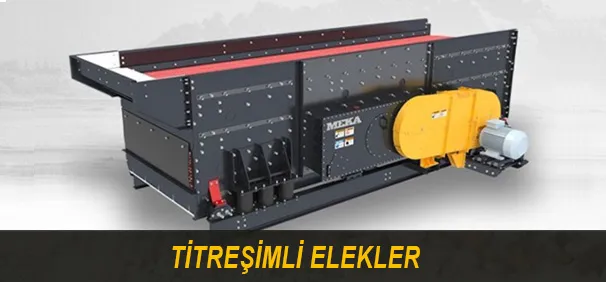
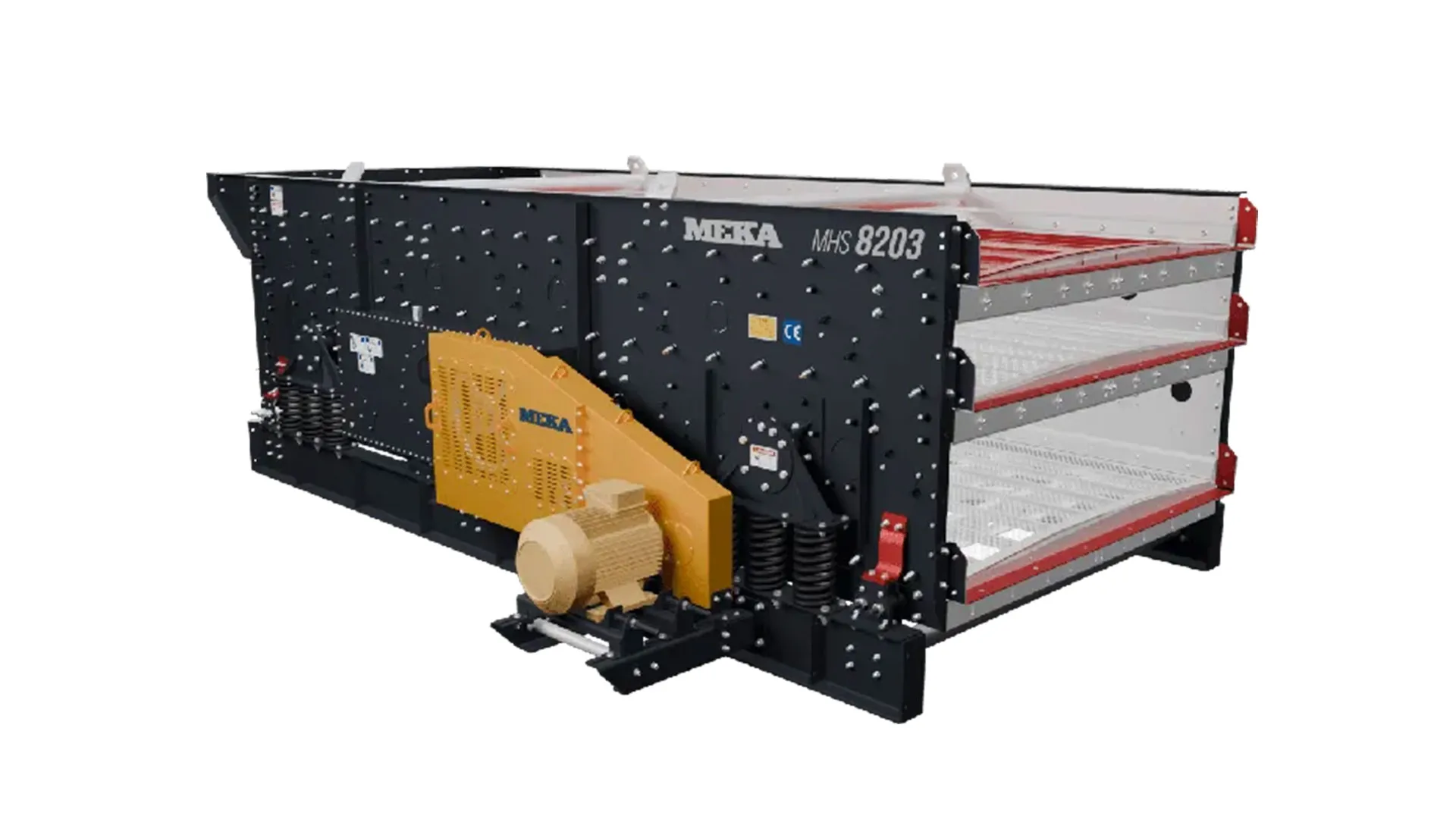
In the mining and aggregate industry, various vibrating machines are used for different operations [1,2]. These machines exist as separate product groups, such as vibrating feeders and vibrating screens. The eccentric drive group in these machines generates the force and forcing frequency required for the vibration motion to occur. Equipment on the machines — such as helical springs, rubber vibration blocks and rosta mounts — is used to determine the natural frequency of the vibrating system and to adjust the vibration amplitude of the system as a whole. Depending on the application, in order to obtain the desired capacity and performance, different vibration motions (linear, circular, elliptical) can be created depending on the machine type. [3,4,5,6].
The machines used are mostly directly exposed to the outdoor environmental conditions, and are also operated under continuous load [7]. For these reasons, over time faults caused by mechanical fatigue, environmental conditions, user errors and/or misuse can occur in the machines [7]. Being able to diagnose these faults early, or to notice them before a fault occurs, is important for ensuring the continuity of the operated plant and/or machine.
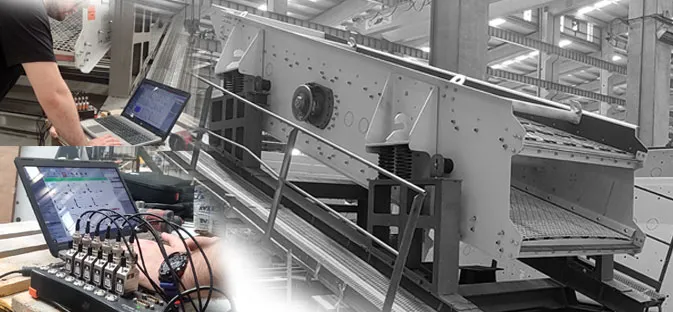
Depending on the machine's operating time and environmental conditions, the vibration value should be measured at certain intervals. To measure vibration values more easily, sensors have been developed. These sensors provide access to the acceleration, velocity and position information of certain points on the machine, thereby making it possible to obtain information about the kinematic properties of the motion. Since one of the important factors affecting capacity in vibrating machines is the vibration motion, accurately determining and measuring the motion character is important for machine performance. Vibration measurement can also be done by reading the vibration card on the vibrating machine. However, this reading, while not being a precise result, gives approximate information about the vibration motion. For this reason, monitoring the vibration motions of the machines with sensors at determined intervals clearly enables us to have information about how healthily the machine is operating. In vibration measurements made with sensors, we can obtain the machine's stroke information and the orbit shape — that is, the shape of the motion. From the machine's orbit shape, we can understand whether the motion the machine is expected to perform is occurring and whether there are deviations from the expected motion. In the orbit graph, in cases where the desired motion has not been obtained for a long time and/or deviations in the motion have occurred, in order to prevent a larger fault from arising and to obtain higher performance from the machine, the machine should continue operation only after the necessary checks have been carried out on it. Likewise, if it is determined from the measurements that the machine is not operating at the desired stroke value, the root cause should be identified and the necessary precautions taken. These checks made with sensors, when appropriate interventions are made and precautions taken at determined intervals, will contribute to reducing the performance losses of the plants and/or machines.
Vibration measurements made with sensors play an important role in terms of predictive maintenance. By monitoring the vibration measurements, maintenance personnel and/or responsible persons can detect possible anomalies in the machine. In this way, unplanned maintenance needs can be forestalled and unplanned stoppages in the plant can be prevented. The use of sensors for vibration measurement is recommended in plants and machines in terms of noticing faults early and understanding how healthily the machines are operating.
REFERENCES
[1] He, X. M., Liu, C. S. (2009). Dynamics and screening characteristics of a vibrating screen with variable elliptical trace. Mining Science and Technology (China), 19(4), 508-513.
[2] Masutage, V. S., Kavade, M. V. (2018). A Review Vibrating Screen and Vibrating Box: Modal and Harmonic Analysis. International Research Journal of Engineering and Technology (IRJET), 5(01), 401-403.
[3] Du, C., Gao, K., Li, J., Jiang, H. (2014). Dynamics behavior research on variable linear vibration screen with flexible screen face. Advances in Mechanical Engineering, 6, 957140.
[4] Chen, B., Yan, J., Mo, W., Xu, C., Zhang, L., Tamma, K. K. (2019). DEM simulation and experimental study on the screening process of elliptical vibration mechanical systems. Journal of Vibroengineering, 21(8), 2025-2038.
[5] Yin, Z., Zhang, H., Han, T. (2016). Simulation of particle flow on an elliptical vibrating screen using the discrete element method. Powder Technology, 302, 443-454.
[6] Zhao, L., Zhao, Y., Liu, C., Li, J., Dong, H. (2011). Simulation of the screening process on a circularly vibrating screen using 3D-DEM. Mining Science and Technology (China), 21(5), 677-680.
[7] Rodriguez, C. G., Moncada, M. A., Dufeu, E. E., & Razeto, M. I. (2016). Nonlinear model of vibrating screen to determine permissible spring deterioration for proper separation. Shock and Vibration, 2016.
MEKA GLOBAL