EN

Crushing & Screening
Spare Parts

From crusher to screen, from washer to feeder — all the spare parts your crushing and screening plant needs, under one roof. With MEKA-manufactured genuine wear and mechanical parts, high stock availability and fast shipping, we keep your plant's downtime to a minimum.

Contact Us


Submit your spare parts request

Crushing & Screening Spare Parts: Genuine Wear Parts, Quality Assurance and Fast Supply

Every hour a plant stands still usually costs far more than the price of the part being replaced. Lost tonnage, delay penalties, a disrupted delivery chain and an operator team idling — within a few hours they start generating a bill. That is why the crushing and screening spare parts decision is not a simple procurement item; it is an efficiency decision.

Plant owners and operators expect three things from a spare parts supplier: to find the part they need in full, to be confident of its quality, and to have it in hand at the right time. Since 1987, as a company that designs and manufactures crushing and screening plants as a whole, MEKA offers all spare parts families — from the jaw plate to the scraper tip, from the idler set to the hydrocyclone liner — through the same quality standard and a single supply channel. More than 4,500 MEKA plants operating in over 110 countries ensure this supply network is tested under real production conditions every day.

This page brings together all the information sought by the purchasing officer, maintenance team or plant manager who needs to procure spare parts for a crushing and screening plant: which parts are offered in which category, which wear material is used where, which information should be ready before ordering, and how to obtain the right product as quickly as possible.

Why MEKA: Manufacturing Authority, Stock Speed and Warranty

In selecting a spare parts supplier, the “genuine or aftermarket” comparison is common; but the real distinction lies in who manufactures the part. Having the same company as the designer, manufacturer and spare parts supplier of the crushing and screening plant provides four fundamental advantages.

Design-based compatibility.
A crusher's jaw plate, a cone crusher's bowl liner, an impact crusher's blow bar — none of these is a stand-alone component; each is part of a system designed together with the main equipment. A spare part prepared by its manufacturer is toleranced to protect the bearing, shaft and gearbox in the main equipment. Even if a third-party part matches the unit dimensions, a small deviation in surface hardness, seating angle or clamping force will over time produce bearing damage, loosening or vibration in the main equipment. The cost of such secondary damage far exceeds the price difference of the part.

Verified material and testing.
A factory-supplied wear part passes chemical composition and hardness tests. The manganese content of a manganese jaw plate, the hardness gradient of a chromium-carbide blow bar, the thickness of a Hardox wear plate — all of these are documented in quality control records and shared with the shipment on request. There is always risk in undocumented supply channels; when a part that looks right is of the wrong hardness, it wears twice as fast or can cause sudden fracture.

Manufacturer's warranty.
Every spare part dispatched by the MEKA after-sales team is under material and workmanship warranty. In third-party channels, warranty coverage, liability sharing and the burden of proof are mostly left to the end user. For the plant, this is not a matter of paper but of who pays the bill for an unplanned failure.

Field data and global logistics.
More than 4,500 MEKA plants in over 110 countries provide the after-sales team with a feedback network under real production conditions: which part lasts how long in which aggregate, which material variant is needed in which condition. This accumulated knowledge feeds directly into spare parts selection recommendations. Thanks to the production centers in Türkiye and a broad warehouse network, high stock levels are held for frequently worn items; for parts requiring special manufacturing, production priority comes into play.

Working with a single supplier has another concrete benefit: all spare parts records, invoice history and delivery times in the plant inventory are consolidated at a single address. This means direct visibility for annual maintenance planning and stock optimization.

Need an offer tailored to your plant?
Reach out via the Request an Offer form at the bottom of the page with your equipment details, and the MEKA after-sales team will get back to you as soon as possible.

Crusher Spare Parts: Jaw Plate, Mantle-Concave, Blow Bar and VSI Wear Parts

Crushers are the equipment exposed to the most intense wear in a crushing and screening plant. MEKA supplies genuine spare parts for all five main crusher families: jaw, impact (primary, secondary and tertiary), cone, hammer and vertical shaft (VSI). For each family the wear points, life expectancy and appropriate material choice differ.

Jaw crusher spare parts

Jaw crushers are the most commonly preferred type in the primary crushing stage. Wear is mainly on the fixed and moving jaw plates; however, cheek plates, wedge sets, eccentric shaft bearings, the toggle plate and the tensioning mechanism are also regularly renewed items.

Jaw plates are produced as Hadfield manganese castings; depending on the abrasiveness of the aggregate, the Mn14, Mn18 or Mn22 variant is preferred. Jaw plate life depends on feed size, aggregate type and operator discipline; on soft limestone it runs significantly longer than on basaltic sites. When the site aggregate's Bond Work Index and Los Angeles abrasion values are provided as information before ordering, the after-sales team gives guidance for the correct manganese variant. In jaw plate orders, renewal as a package together with the cheek plate and fixing wedge set is a common choice; this keeps line loss during renewal to a minimum.

Impact crusher spare parts (primary, secondary, tertiary)

In impact crushers the center of wear is the blow bar. In primary impact crushers, chromium-alloy blow bars are preferred, while in the secondary and tertiary stages harder chromium-carbide-alloy or ceramic-reinforced blow bars are chosen. Besides the blow bar, rotor disc wear plates, cover inner liners, body wear plates, impact aprons, tension bolt sets and rotor bearings are subject to regular renewal. When the blow bar reaches a certain wear level, it can be turned over on the rotor to gain a second service life; done at the interval and machining technique recommended by the manufacturer, this practically doubles the part's life.

Cone crusher spare parts

Cone crushers are the heart equipment of the plant for fine and medium aggregate production; therefore the mantle and bowl liner (concave) are both the most frequently changed and the most critical wear items. In addition, the head guard, dust seal, base rings, hydraulic cylinders, clamping-system parts and gearbox components are natural items of the spare parts program.

For cone crushers MEKA offers different mantle-concave sets varying in manganese content and tooth profile: standard, extra fine, extra coarse and, for special sites, variants with a differentiated heat-treatment profile. The correct choice of mantle-concave set directly affects both the product particle shape and the crusher's energy consumption — a wrongly chosen set reduces the salability of the sand produced.

Hammer crusher spare parts

Hammer crushers provide high production capacity on soft and medium-hardness rocks, especially on limestone and marl-type sites. Wear concentrates on the hammer heads, cage plates, side plates and interchangeable grates. Grate spacing modification — that is, changing the grate spacing set to alter the output aggregate composition — is a frequently used spare parts application for cross-site usage flexibility.

Vertical shaft impact (VSI) crusher spare parts

Vertical shaft impact crushers produce a cubical particle shape and are critical equipment for ready-mix concrete and asphalt aggregates. Their wear points are different: rotor blocks, anvil rings, table head caps, distributor discs, wear sleeves and tungsten-carbide-tipped tip variants. The correct operating time and wear part selection of VSI crushers directly affect the sand equivalent value and particle shape of the sand produced, which is the most important quality indicator for ready-mix concrete production.

Which crusher are you looking for parts for?
Share your equipment serial number and aggregate type via the Request an Offer form; let our team recommend the right material variant.

Screen Spare Parts: Screen Media, Polyurethane Module, Spring Assembly and Eccentric

Screening is the stage where efficiency and product quality are directly determined. Between two plants of the same crushing capacity, the one that selects the right screen media and the right vibration mechanics produces far more salable aggregate. Screen spare parts are addressed under two major headings: the screen surface material (i.e. screen media or modules) and the vibration mechanics.

Screen media and modules

Three basic materials are preferred for the screen surface. Woven metal media — provide long life at high abrasiveness, have a high open area, but their noise and wear profile is aggressive. Polyurethane modules — thanks to the modular structure they offer easy local replacement, low noise and resistance to sticking in wet screening; but their open area is lower than metal media. Rubber modules — preferred especially in scalper or primary screening stages exposed to heavy impact and large-particle flow. Hybrid solutions — using rubber or metal on the upper decks and polyurethane on the lower decks — optimize wear resistance and permeability together.

MEKA can customize all these material options for the inclined, horizontal, grizzly, scalper and dewatering screen families according to the customer site's aggregate type and target particle composition. Module thicknesses, hole shapes (square, rectangular, oval, slot), deck fixing systems and end caps are supplied at genuine quality. For a sand-washing screen, choosing a polyurethane module reduces sticking in wet conditions for cleaner separation; on screens producing fine aggregate, the module hole dimensions are calibrated to the product specification.

Spring assemblies, eccentric and vibration unit

The “heart” of the screen is the vibration group. Spring assemblies — fixed-calibrated helical springs or rubber-mounted isolators — directly determine the deck oscillation amplitude. Fatigued or de-calibrated springs reduce screening efficiency imperceptibly; a monthly drop of 2-3% turns into a loss of salable product by year-end. The eccentric shaft, eccentric bearings, balance weights and vibration motors form the screen's energy transmission line. Renewing the springs as a set prevents chassis fatigue caused by unbalanced oscillation — which is why the after-sales team recommends replacing the whole set rather than a single spring.

Chassis protection, product separation and accessories

The screen's side plates, head-and-tail parts, deck side guards, product-separation plates and feed-box wear plates are items that need renewal over time. These plates are usually delivered in the Hardox class, laser-cut. On the accessory side, deck fixing clamps, high-strength fastening bolts, sealing gaskets and complete assembly kits are kept in stock.

If your screen modules are fatigued, reach out via the Request an Offer form at the bottom of the page for the material variant suited to your site.

Washer Spare Parts: Spiral Blade, Paddle Tip, Bearing and Sealing

Washers — whether a fine/coarse material spiral washer, a log washer or a compact sand plant — operate continuously under a flow of water, mud and abrasive material. For this reason their spare parts programs have different priorities from other categories; besides wear, corrosion and sealing are a subject in their own right.

Spiral wear parts and paddle tips

In fine material washers, the outer edges of the spiral blades are the fastest-wearing zone. When this wear is not monitored, washing performance drops first, then the spiral's conveying capacity decreases and eventually the washer starts operating below capacity. Spiral blade wear plates extend life through local renewal; at advanced wear, renewal is done with a complete spiral replacement set.

On the log washer side the most critical part is the paddle tips. A common field mistake is to replace only the tips while skipping their root fixing bolts; bolt looseness disrupts the shaft balance and strains the bearings. In tip sets dispatched by the manufacturer, the bolt, nut, locking washer and sealing ring come together. This package approach prevents the bearing-damage cost created by piecemeal supply chosen because it “seems cheaper”.

Bearing assemblies, sealing and shaft protection

In washers, the bearing assemblies are the most sensitive mechanical element operating in wet conditions. Besides the lubrication program set by the manufacturer, maintaining the sealing directly determines bearing life. Standard sealing felts, labyrinth seals and reinforced sealing kits for special-condition sites are kept in stock. Shaft wear sleeves are a critical item that prevents the shaft from wearing in the sealing zone and, when replaced, protects the shaft itself; this sleeve is one of the most important protective investments for lowering the main shaft replacement cost.

Compact sand plant parts

Compact sand plants are integrated structures where the hydrocyclone, dewatering screen and pump group work together. The spare parts program works separately for each sub-component of this structure: the hydrocyclone liner (apex and vortex), the pump volute rubber, the impeller, the dewatering screen bearings and spring assemblies, and the motor coupling sets. For compact sand plants MEKA supplies these sub-group spare parts through a single channel — without having to source them separately from different component manufacturers. This reduces logistics complexity and simplifies invoice tracking.

If your washer performance has dropped, get support from our after-sales team for a site-specific assessment.

Feeder Spare Parts: Apron Pallet, Grizzly Bar, Belt and Wobbler

Although the feeder looks like a sub-stage rather than a piece of equipment, it is one of the components that most affect the plant's tonnage and continuity. An unplanned feeder stoppage leads to a pile-up or emptying across the whole line within an hour. That is why feeder spare parts are treated as a critical stock item.

Apron feeder parts

In apron feeders, the pallets, chain, links, rollers, tensioning group and drive sprocket are subject to regular renewal. Pallets are offered in Hardox or manganese-casting options; chain links and roller sets are supplied to a standard calibrated to the feed load. The original pallet molds kept by the manufacturer in the production archive mean that spare parts can be supplied without dimensional mismatch even for an apron feeder more than ten years old.

Wobbler feeder parts

Wobbler feeders are special solutions that combine pre-screening with feeding. The main worn items are the shaft assemblies, gear liners, shaft bearings and body wear plates. The shaft bearings are directly linked to the lubrication program; the most common field mistake is to solve the bearing damage caused by skipped periodic lubrication with a complete shaft replacement rather than a spare part supply. Early bearing renewal is the most economical way of protecting the shaft.

Grizzly vibrating feeder parts

This type of feeder combines pre-scalping with feeding. Wear concentrates on the grizzly bars, spring assemblies, the eccentric mechanism and the motor mounting connections. Grizzly bars are offered in manganese-casting or Hardox options; customizing the gap between grizzly bars to the customer site (spacing modification) is a frequently requested supply type. For plants wishing to change the output aggregate composition, this modification is the most effective intervention that can be made without changing the equipment.

Belt feeder parts

Belt feeders are used to convey tonnage in a controllable flow. Wear is mainly on the conveyor belting, idler set, drive drum, tail drum, tensioner and scraper. Belt feeder spare parts largely overlap with conveyor spare parts and the same quality standard applies.

Pan and vibrating feeder parts

In pan and vibrating feeders, wear is on the pan inner wear plates, side wall guards, springs and the eccentric or vibration motor. Wear plate kits are usually dispatched as a package including the plate, mounting bolts and sealing gaskets; this approach shortens assembly time and eliminates the problems caused both by individually sourced parts and by assembly mismatch.

Is your feeder spare parts stock low?
Reach out via the Request an Offer form for an annual spare parts package recommendation tailored to your plant.

Conveyor and Belt Spare Parts: Idler, Drum Lagging, Conveyor Belting and Scraper

In a crushing and screening plant the total belt length easily reaches hundreds of meters; on it run hundreds of idlers, dozens of drums and dozens of scrapers. Therefore conveyor spare parts are the category with the highest item count, and the right supply strategy determines a significant part of the plant's total spare parts cost.

Idler sets

There are three basic idler types on a conveyor: carrying idlers (on the top, with material flowing over them), return idlers (on the bottom, carrying the empty belt) and impact idlers (in the feed zone, impact-absorbing). MEKA keeps different bearing classes, sleeves and coating profiles for all three types in its genuine stock. Idler bearing quality directly affects both belt life and motor energy consumption: a poor bearing increases friction, and motor load and the energy bill rise together. When the annual idler replacement rate is planned in the 5-15% band according to plant size, stocking critical items is a cost-effective strategy.

Drive and tail drum

The drive drum is the main surface transmitting the motor's movement to the belt. The drum surface coating (lagging) — rubber or ceramic-reinforced rubber — is a critical element preventing belt slippage. Worn lagging creates a loss of grip on the belt; this shows up as an increase in motor load and, over time, edge wear on the belt. The tail drum, together with the tensioner, adjusts belt tension. Offering just a lagging renewal kit rather than a complete drum spare is, in most cases, more advantageous both in cost and in assembly time.

Conveyor belt selection

Conveyor belt selection is one of the crushing and screening plant's quiet but, in the long term, most expensive decisions. EP (polyester-nylon) carcass belts are general-purpose and sufficient for most standard aggregate applications. Steel cord carcass belts are preferred for long-distance and high-tonnage conveying; although their initial investment is high, they can be advantageous in total cost of ownership over long distances. Wear-resistant cover grades (ISO classification categories Y, X, W) are selected according to the abrasiveness of the aggregate. Heat-resistant belts are reserved for hot aggregate and clinker-type applications. MEKA offers site-specific belt options together with cutting-to-length, splicing and installation service.

Scrapers and accessory items

The primary scraper (in front of the drive drum) and the secondary scraper (at the drive drum exit) clean the material left on the belt and prevent it from contaminating the idler and return side. A worn scraper shortens belt life and creates material build-up on the return idlers — which raises the idler replacement rate. Besides scraper sets, consumable items such as belt cleaning brushes, skirting rubbers, tensioner bolts, V-belts and assembly kits are also supplied through a single supply channel.

Critical items on your conveyor line should be stocked.
Request an assessment from our team for a spare parts package tailored to your plant.

Wear Material Quality: Manganese, Chromium Alloy, Hardox and Polyurethane

In crushing and screening spare parts, the topic of “material” is one of the sources of the price difference and, when understood correctly, one of the most critical items in the profit-and-loss picture. MEKA wear parts cover three main metallic material families plus an additional polymer-rubber group.

Hadfield manganese steel

Hadfield manganese (high-manganese steel) is a unique material that gains surface hardness under impact. The relatively soft surface at first installation undergoes work hardening with material flow and shows resistance to wear. Different variants are preferred according to manganese content: Mn14 is the standard choice for medium-hardness aggregates; Mn18 is preferred for hard aggregates and heavily working primary jaw crushers, where work hardening occurs faster; Mn22 is used in special applications, especially in blow bars exposed to high impact load and in plants with large-particle feed.

All these variants are offered for jaw plates, mantle-concave sets, grizzly bars and apron pallet items; the correct choice is made based on the site aggregate's Bond Work Index and Los Angeles abrasion values.

Chromium-alloy cast steel

Chromium-alloy cast steel works with a different wear mechanism than manganese: its surface hardness is high from the start and does not need work hardening. This makes it more efficient in the secondary and tertiary crushing stages — that is, at points where the impact sufficient for manganese work hardening does not occur.

As chromium-carbide content increases, wear resistance rises; but brittleness also rises, so especially in impact crusher blow bars the optimum choice is made at defined chromium/carbon balances. Different chromium-alloy profiles are kept in stock for impact crusher blow bars and the appropriate type is selected according to the crusher stage.

Hardox wear plates and steel-plate liners

Hardox is a family of high-strength, wear-resistant steel plate produced by SSAB. Hardox 400, 450 and 500 are classes in different hardness ranges.

Hardox is the preferred material in chute liners, transfer-point liners, feeder pan liners, the screen's head-and-tail guards and general steel-plate protection applications. Steel wear plates are laser-cut; the connection clearance and welding surfaces are delivered with a precision that matches the original equipment.

Polyurethane, rubber and ceramic reinforcement

Wear material is not limited to metal. Polyurethane modules on screens, rubber linings on washer chutes, special-compound rubber surfaces on scraper tips and elastomer solutions in transfer-point impact cushions are used.

In addition, ceramic-reinforced rubber for drive drum lagging is preferred in high-tonnage applications. This material group provides a critical performance advantage in terms of anti-sticking, noise control and impact absorption.

Fast Ordering, Stocked Shipment and Plant-Specific Spare Parts Package

Every hour spent on a spare parts order is a cost for the plant. To supply the right part as quickly as possible, the after-sales team needs a certain set of information. Preparing the right data before ordering can reduce the process from days to hours.

Information that should be ready before ordering

    • Equipment serial number and year of manufacture: Even different serial numbers of the same model may have a part version difference.
    • Total operating hours or cumulative tonnage: Critical data to verify the wear part's replacement time specific to the site.
    • Clear photo of the worn part: If possible, an image taken in place before the part is removed, including a scale reference.
    • Aggregate type and abrasiveness information: Required to select the right material variant. If Los Angeles and Bond Work Index values are available, they must be shared.
    • Site location and shipping preference: Road, sea container or air cargo options directly affect delivery time.

Communication channel choice

      In an unplanned stoppage, WhatsApp and direct phone provide the fastest response. For planned spare parts stocking or service package requests, sharing detailed information via the offer form produces a more accurate quotation. E-mail is preferred for cases where photos and technical documents need to be shared. The 24/7 support line provides direct access to the after-sales team in emergencies regardless of country.

Stock and special-manufacturing distinction

      For frequently worn items, MEKA holds a high stock level at its factory. For these items the supply time consists mainly of the logistics process. For less frequently renewed parts or those requiring a special combination, production priority comes into play; in this case correct time planning is important. A plant-specific annual spare parts package plan stocks frequently worn items in advance and turns special manufacturing into a planned order. This package lowers stock cost, reduces the risk of unplanned downtime and makes the annual purchasing budget predictable.

Plant-specific spare parts package

      Plant-specific spare parts packages prepared according to annual tonnage, equipment fleet and aggregate type are fed by the after-sales team's field data and global feedback network. The package offers a clear plan of which item will be renewed how often, which will be stocked and which will be supplied to order. This approach standardizes purchasing processes, especially for groups operating more than one plant.

Would you like an annual package recommendation tailored to your plant?

        Share your equipment fleet via the Request an Offer form at the bottom of the page, and the MEKA after-sales team will get back to you with a detailed analysis.

Frequently Asked Questions

How much longer does a genuine MEKA spare part last compared to an aftermarket one?

Giving a precise multiple on its own is misleading, because the result depends on aggregate type, feed size and operator discipline. According to field feedback, genuine wear parts last longer than aftermarket ones and reduce the risk of secondary damage. In terms of total cost of ownership, they are more advantageous in most cases.

Is there a minimum order value requirement for my spare parts order?

No standard minimum value is applied. Each request is evaluated according to the logistics and shipping plan; optimization suggestions may be offered for small orders.

What is the fastest delivery time for an urgent part?

For parts in our stock, delivery time depends on the logistics setup. In emergencies, air cargo and express shipping options are considered. Direct contact is recommended for the fastest planning.

Are spare parts available for machines 10 years old and older?

Yes. Spare parts support is provided for all active equipment regardless of manufacture date. Archive drawings are used for old serial numbers, and special production is carried out when needed.

Are a wear part and a spare part the same thing?

No. Wear parts are items that are regularly replaced (pallet, jaw plate, etc.). A spare part is a broader concept that also covers the motor, bearing, hydraulic and electrical components replaced in the event of a breakdown.

What is the spare parts warranty period?

The warranty period varies according to the part type. For wear parts, material and workmanship defects are covered. The exact period is stated at the offer stage.

Can MEKA spare parts be used on other machines?

Some wear parts can be used on different brands when dimensional compatibility is ensured. Brand-model and dimensional information is required for correct matching

Are field support and measurement services provided?

Yes. The field team can provide services for thickness measurement, installation support and maintenance planning. The request is planned according to the equipment serial number.

Is a long-term spare parts plan prepared?

Yes. A plant-specific stock plan is prepared through an annual production- and tonnage-based analysis. This reduces the risk of unplanned downtime.

What is the difference from non-MEKA suppliers?

MEKA is a manufacturer that produces the equipment and the spare part to the same engineering standard. This offers a more consistent system in terms of compatibility, quality and life.

For Orders or Offers

The MEKA after-sales team is directly reachable for the supply of genuine spare parts and technical consultancy in all the categories above.

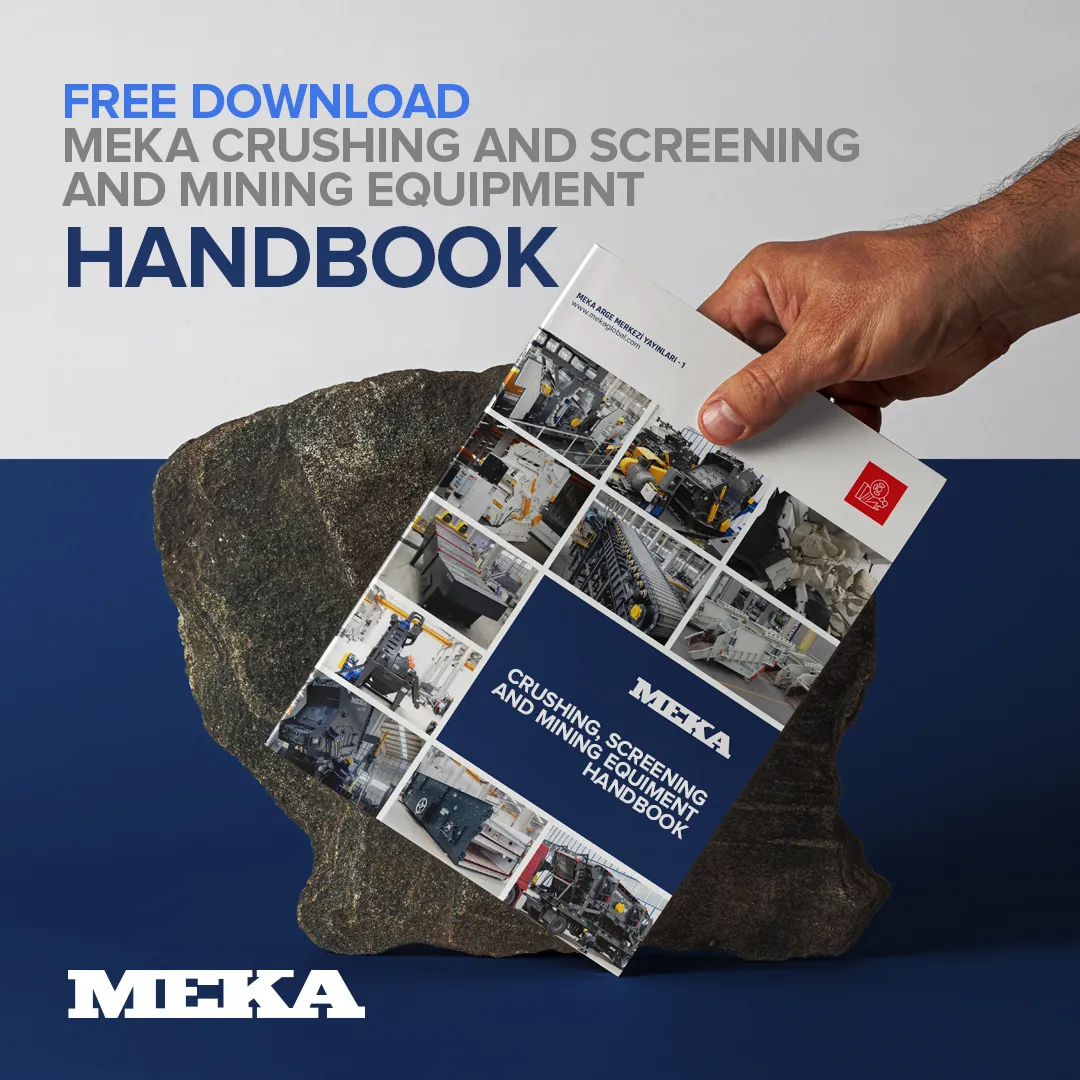
For a quick offer you can fill in the Request an Offer form at the bottom of the page, get in instant contact via WhatsApp or download the Crushing, Screening and Mining Equipment Book to review the product families in detail.