What Is a Concrete Block? Uses in Construction and Advantages

In the construction sector, materials that deliver both speed of construction and long-lasting performance come to the fore. The concrete block, with its modular structure and its options in different densities and dimensions, is a wall element widely used in residential, industrial and landscaping projects. Offering advantages such as thermal and sound insulation, fire resistance and ease of workmanship, the use of concrete blocks has today become an indispensable part of modern building techniques. This article discusses in detail the definition of the concrete block, its types, areas of use and the technical advantages it provides.
What Is a Concrete Block?
The concrete block, commonly known as a CMU (Concrete Masonry Unit), is a modular wall element produced by moulding a cementitious binder, lightweight or normal-weight aggregate, water and performance admixtures with a vibro-press. The units are generally produced hollow; this reduces weight and improves thermal and acoustic behaviour. Standardized dimensions support fast, repeatable wall construction across a wide range of applications, such as non-load-bearing partitions, infill walls, garden/boundary walls and industrial partitions.
Depending on the manufacturer's mix, the blocks can be lightweight (e.g. pumice-based) or normal-weight (e.g. sand-gravel/slag-based). The typical bulk density ranges from about 800 to 1800 kg/m³. The material saving provided by the hollow geometry lowers the unit weight of the wall while also improving its service performance. In the Turkish market, the modules informally called "20" (≈190×390×190 mm), "15" (≈140×390×190 mm) and "10" (≈90×390×190 mm) are frequently used; dimensions and void ratios may vary between manufacturers.
What Are the Types of Concrete Blocks?
Pumice-based (lightweight) block:Produced with natural pumice; it is quite lightweight. It performs well against heat transfer and is easy to cut and work on site. It is mainly preferred for interior partition walls and frame-infill applications.
Concrete (normal-weight) block: A standard, durable block produced with sand and gravel. Since it is more resistant to external effects, it is suitable for outdoor applications such as garden walls, fences and boundary walls.
Slag/special-aggregate block:These are blocks made with special aggregate mixes, designed for particular targets such as a specific density or extra strength.
Geometric variants:Many shapes are available, such as half blocks, corner blocks and channelled blocks for utility runs; this makes joint staggering and electrical/plumbing pass-throughs easier.
The Advantages of Using Concrete Blocks
Speed of application and efficiency:The large module size means fewer units per m² and shorter laying times. Application cycles speed up and construction productivity rises.
Thermal comfort:Lightweight blocks provide very good thermal insulation; the hollow structure traps air and increases the effect. When applied correctly, it limits the formation of thermal bridges.
Acoustic performance:The combination of unit mass and hollow cross-section contributes to sound absorption. At standard thicknesses, the sound comfort between rooms is high.
Fire safety:Concrete blocks are non-combustible (Class A1). The mineral structure and hollow cross-section provide notable fire resistance for a period of time, limiting the spread.
Workability and less waste:On-site cutting/shaping can be done with simple hand tools. Utility recesses are opened cleanly, reducing breakage and waste.
Budget-friendly:Fast production, fewer blocks per m² and lower mortar consumption reduce the total wall cost.
Where Are Concrete Blocks Used?
Concrete blocks are widely used in building and infrastructure projects for walls, retaining structures, landscaping and industrial-plant construction. Thanks to their durability, low cost and quick applicability, they are preferred in residential, industrial and agricultural structures.
Residential projects:Infill and partition walls within the structural system.
Garden and boundary walls:External walls with a plinth and bond beam.
Industrial structures:Production-area partitions, warehouse divisions, fire compartmentation.
Technical spaces:Spaces with acoustic and fire requirements, such as shafts, machine rooms and generator/transformer rooms.
Brick or Concrete Block? A Material Comparison
The values are typical; they may vary according to product class, thickness and project conditions.
| Criterion | Lightweight Block | Normal-Weight Block | Clay Brick (Perforated) |
| Bulk Density | ~800–1200 kg/m³ | ~1500–1900 kg/m³ | ~1200–1600 kg/m³ |
| Compressive Strength (Unit) | Medium | Medium–High | Medium |
| Thermal Conductivity λ (dry) | ~0.12–0.25 W/mK | ~0.40–1.00 W/mK | ~0.25–0.45 W/mK |
| Wall-Laying Speed | High | High | Medium |
| Plaster Consumption | Low–Medium | Low–Medium | Medium |
| Fire Performance | A1, Very Good | A1, Very Good | A1, Very Good |
| Workability (Cutting/Channelling) | Easy | Medium | Medium |
Lightweight blocks offer advantages in workmanship and thermal performance; normal-weight blocks stand out where resistance to external effects and high strength are expected. When traditional detailing and fine workmanship are prioritized, clay brick remains suitable.
Application and Detailing Recommendations
Bed and perpend (vertical) joints:Use a mortar class compliant with TS/EN (e.g. M5). The typical bed-joint thickness is 10 mm; the perpend joints must be filled completely and continuously.
Vertical staggering (bond):Provide at least 1/3, preferably 1/2, block offset.
Connection to the structural system:Instead of resting against a column/shear wall by friction, use mechanical connections such as stainless-steel connecting strips and wall anchors.
Horizontal bond beams:Reinforced bond beams at floor levels improve in-plane rigidity and seismic behaviour; open voids should be integrated with the bond beam.
Door and window openings:Use a ready-made lintel or a cast-in-place reinforced-concrete lintel over the openings. Confirm that the lintel rests on a sufficient bearing length on both sides.
Waterproofing:Use water-repellent plaster/render on external walls. Make sure that all joints, especially the perpend joints, are completely filled. Fully resolve the waterproofing at wall-foundation junctions.
Thermal bridges:Corners and wall-column junctions are critical points. Maintain the fill of the perpend joints. When creating a continuous thermal barrier with external thermal insulation systems (ETICS/cladding), pay particular attention to these points.
Improving sound insulation:When high acoustic performance is required, prefer a double-leaf wall with a gap and a flexible acoustic layer in between, or structurally separate leaves.
Utility pass-throughs:Do not remove intermediate webs without permission. If a reduction in section is required, obtain project approval.
Typical Technical Data
These are representative values; for design, refer to the product's TDS and the relevant standards.
| Parameter | Lightweight Block (Pumice) | Normal-Weight Block | |
| Nominal Dimension (Example) | 190×390×190 mm | 190×390×190 mm | |
| Void Ratio | %30–55 | %25–45 | |
| Bulk Density | 800–1200 kg/m³ | 1500–1900 kg/m³ | |
| Dry Thermal Conductivity λ | 0.12–0.25 W/mK | 0.40–1.00 W/mK | |
| Fire Class | A1, Very Good | A1, Very Good | |
| Typical Wall Thickness | 100 / 150 / 200 mm | 100 / 150 / 200 mm | |
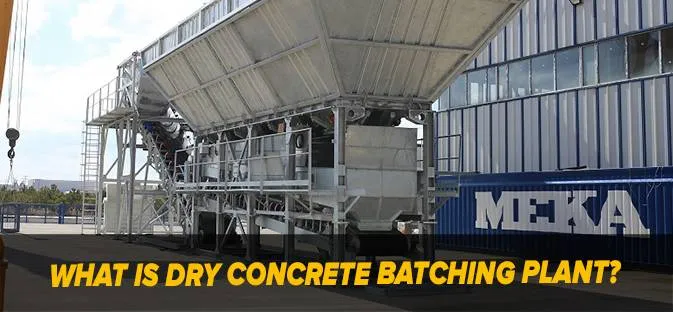
For the concrete/mortar preparation and aggregate classification processes used in concrete block production, you can also take a look at our concrete batching plants and mobile screens solutions.
Frequently Asked Questions (FAQ)
Can a concrete block wall be load-bearing?
Generally no. CMU walls are used as infill or partition within a frame. If load-bearing capacity is desired, design, testing and compliance with standards are mandatory.
Can it be used on external walls?
Yes. It can be used with suitable plaster/render, waterproofing and thermal-insulation detailing. The surfaces must be protected against freeze-thaw and precipitation.
How is the mortar class chosen?
The function, exposure and block strength are taken into account. M5 is typical for residential partition walls; external environments and higher loads require higher classes.
What matters in sound insulation?
Mass and continuity. Make sure the joints are completely filled; improve performance with a double-leaf wall, a gap and flexible layers.
With its modular geometry, quick application and mineral composition, the concrete block meets the needs of the modern construction site. Selecting lightweight or normal-weight units according to the project goals makes it possible to optimize thermal, acoustic and fire performance. For long life and reliability, correct detailing and quality control are decisive.
MEKA GLOBAL