Design Optimization by Examining Particle Dynamics in Crushing-Screening Equipment
As cities and human settlements grow and are renewed, and as the need for social amenities in addition to housing structures increases, construction activities worldwide are developing with ever-increasing momentum. In parallel with this development, the need for construction raw materials such as concrete, cement, asphalt and ballast, as well as for minerals, is also increasing. In meeting this need in terms of quality and quantity, and in recycling the debris of old structures in renewal projects, the use of crushing-and-screening plants and related equipment is gaining importance.
The correct application, in crushing-and-screening technologies, of size reduction — the first stage of mineral processing — is increasingly gaining importance in the mining sector. During the processing of aggregates and ores, which undergo many different processes until they become suitable for use as a final product, they pass through a series of beneficiation operations such as crushing, grinding, classification, washing and dewatering.
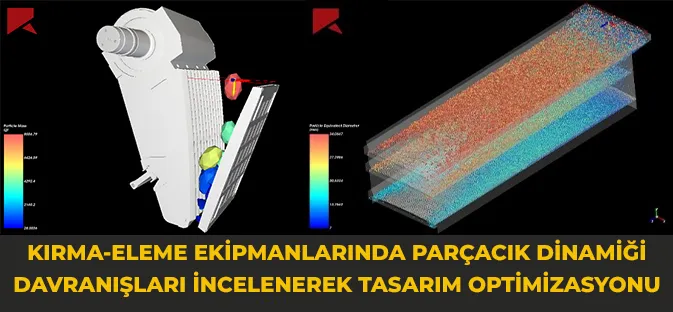
For this reason, being able to calculate the forces that arise on the particles and the stresses that these forces create on the equipment is of great importance. When carrying out calculations in these process operations, numerically analysing the near-real behaviour of the particles together with the equipment they are in contact with makes it possible — by optimizing the performance of the machines and equipment in question — to reduce design and operating costs while improving efficiency and product quality in large-scale industrial processes.

*The breakage behaviours of ores have been examined specifically for the jaw crusher, allowing an assessment of the forces that arise on the crusher equipment during breakage and of the size distribution after breakage.
In this regard, the Discrete Element Method (DEM), developed by Cundall and Strack4 (1971), reveals the interaction between particles and boundaries in order to calculate the behaviour of solid particles, and thus plays a critical role in gaining insight into design-oriented processes. Through simulation studies carried out by the engineers of the R&D Center within MEKA A.Ş. using the Rocky DEM program:
In addition, as a result of these simulation studies, calculation-based predictions are made of the power, energy and efficiency values, and of the wear that occurs on the equipment when the machine components are subjected to heavy loads, and solution proposals for optimum performance are offered.
*For classifying the crushed material according to its size, the different screen types in the company's product range are examined under various parameter conditions such as frequency, amplitude, vibration trajectory and operating inclination.

In this way, common operational problems — from clogging to unwanted build-up and the resulting variation in grain distribution and irregular sizing — are eliminated, thereby preventing unplanned stoppages.

*In the transfer of bulk materials between conveyor belts, in the chutes and transfer chutes used at the crusher and screen outlets, the most frequently encountered problems are clogging caused by material build-up, an uneven flow distribution that does not advance in a uniform direction, and chute and liner wear.

For the behaviour of bulk material on the conveyor belts used as the transfer system for material handling, for the efficient provision of its conveyance, and for preventing spillage during loading and unloading, solution proposals are offered that eliminate the problems the design must address. In this way, an increase in asset service-life expectancy is achieved.

To prevent these problems, the flow of the material is controlled, thereby increasing equipment life and achieving optimum conditions.

*When the run-of-mine material is highly moist and sticky, Apron Wobbler feeders — an indispensable piece of equipment in the crushing-and-screening process — make it possible to reach ideal working conditions so that high capacity is maintained, by screening out problems such as the clogging that wet and sticky materials can cause both on the screens and in the feeders.

*In the bucket design of the Bucket Wheel Washers in our washing product range, thanks to obtaining a grip angle that provides the power and capacity values in a coupled manner, the desired efficiency values are achieved in aggregate washing operations.
In addition, in these feeders, the flow characteristic that the bulk material must exhibit in order to be fed to the crusher or another piece of equipment at a uniform rate has been optimized for efficiency by examining the movement of the particle, its residence time on the feeder and the effects of particle velocity.

In addition, in order to obtain the optimum capacity and power values together, the parameters affecting the screw (spiral) design were examined and design improvements were made. In this way, results at the desired levels in terms of performance and stability are achieved. The contact behaviour of bulk aggregates and ores in motion and the material flow regime vary according to the material type. The mineralogical properties of ore types — whose physical properties and chemical compositions are shaped according to different geographical locations — also show variety. Consequently, because materials of different characteristics are processed in the plants, process-specific equipment designs also emerge. In traditional methods, equipment designs are mainly shaped according to in-house experience, laboratory-scale experiments, or changes in the process parameters during operation. This approach brings a number of problems when uncertain boundary conditions and changing requirements have to be taken into account, and it reaches its limits entirely when an optimal solution must be found systematically. This makes it more efficient and consistent to design machinery in a plant by taking geometallurgical parameters into account. For this reason, because of this variety, the equipment in the crushing-and-screening circuit requires design work specific to the ore or aggregate it will interact with. Taking the aforementioned factors as a reference, since plant equipment does not operate on the basis of a single variable, design work must be carried out taking the properties of the aggregate and ore into account.
The fact that the Discrete Element Method (DEM) can appropriately model the granular flow of large numbers of particles and is an effective method in rock mechanics2 is one of the most important scientific developments in the mining industry. For example, the design of screens — which are, in effect, the heart of the crushing-and-screening plant — has a direct effect on screening efficiency, the quantity of target products, the total power consumption, and the profitability of the ore-processing plant through the efficient operation of the crushers.1 For this reason, in the studies carried out, many design variants are simulated beforehand in order to better understand the effect of a change on the overall process. Consequently, making use of technology and specially developed programs, in addition to experience, is important for the optimization of projects.
Since most solids, especially minerals, are not of a uniform size, they exhibit different types of behaviour. In this respect, in order to enter the boundary conditions in DEM simulation studies, ores are subjected to various laboratory experiments. In this way, by obtaining a close correlation between the experimental and numerical results for the input parameter values3, the interaction parameters of the particles with surfaces are calibrated. This makes it possible to reflect the dynamic processes of the particles4 in a way that enables the correct definition of the working conditions, helping engineers to make decisions and, at the same time, optimizing the system equipment. Among these experiments, single-particle breakage tests — which adopt a series of empirical models called the Ab-T10 and the Tavares Breakage Model7 for breakage behaviour under impact — uniaxial compressive strength (UCS) tests, and inclined-plane and angle-of-repose experiments are carried out. Thus, the Young's modulus (E) and Poisson's ratio (ν), the micro-elasticity modulus and the stiffness ratio — which are among the deformation properties of ores — are defined.5 The wear behaviour of the liner equipment is addressed on the basis of Archard's wear model. To improve the liner service life, the amounts of wear and, accordingly, the equipment lifetimes are determined.
For obtaining accurate simulation results for aggregates and ores, after the boundary-condition inputs containing the material properties are correctly defined, at MEKA A.Ş. an optimum design methodology — specific to mine, quarry and sand-pit plants — is carried out according to the operating principles of all crushing-and-screening equipment that interacts with particles. In this way, with a completely new and accelerated approach to process design and optimization, the way is opened for product development, and the workload spent on tests and prototypes is minimized. Considering the time it takes for equipment to be revised, it can be said that the time lost in design has fallen by a relative 45–50% compared with the past. To ensure production continuity in the plants, predictions are made about maintenance periods and estimated times are given for procuring spare parts; liner wear is minimized; and by preventing interruptions in the workflow and maintenance downtime, the negative factors that machine breakdowns would cause are eliminated, thereby increasing machine life. Thus, solutions are offered so that efficiency and quality are provided under the most suitable conditions in crushing-and-screening plants and stable results at the desired values in terms of cost and performance are obtained. Under Law No. 5746, the R&D Center of MEKA A.Ş. was registered as of 2021. It continues its R&D work in coordination with the Ministry of Industry and Technology, and its test facilities, measurement capabilities and laboratory facilities are being enriched within this framework in line with project requirements. The R&D work within the company is carried out using the ANSYS MECHANICAL, ANSYS FLUENT, ROCKY DEM, SAP 2000, SOLIDWORKS and INVENTOR software infrastructures. The design and capacity calculations of the turnkey crushing-and-screening plants requested by client organizations are carried out by experienced engineers through the AGGFLOW software. The MEKA R&D Center, the strongest of its kind in Turkey, continues its contributions to technical and academic knowledge in the light of science, in addition to high-value-added product designs.
MEKA GLOBAL