Mohs Hardness Scale Explained: A Practical Guide for Aggregate Engineers
Mohs Hardness Scale Explained: A Practical Guide for Aggregate Engineers
Understanding the Mohs hardness scale, its impact on crusher selection, wear part lifespan, and the link to Bond Work Index, UCS and abrasion data tabulated in the MEKA handbook.

Every crusher selection, every wear part order, and every kilowatt-hour of grinding budget in an aggregate operation traces back to a single physical property: the hardness of the rock you are processing. Modern engineering relies on quantitative measures — Bond Work Index, Uniaxial Compressive Strength, Abrasion Index — but the fastest field assessment of how a rock will behave under load still begins with a 200-year-old comparative test: the Mohs Hardness Scale.
Established in 1812 by German mineralogist Friedrich Mohs, the scale ranks ten reference minerals from talc (1) to diamond (10) by their relative resistance to scratching. For aggregate engineers, Mohs is rarely the final word — but it is almost always the first. A site engineer who knows that limestone falls around Mohs 3–4 while quartzite sits at 7 already knows whether a hammer crusher will earn its keep or whether a jaw-and-cone configuration is mandatory. A purchasing manager who reads “Mohs 7+” on a feed analysis already knows the wear part bill will lean heavily on 18 % manganese steel.
This guide unpacks the Mohs scale specifically for aggregate processing — the values, the equipment implications, and the link to the other physical properties (Wi, Ai, UCS) tabulated in the MEKA handbook.
Mohs Hardness Scale Explained
What is the Mohs Hardness Scale?
A Brief History (Friedrich Mohs, 1812)
Friedrich Mohs was a German mineralogist who, in 1812, proposed a simple and elegant solution to a problem that had plagued natural science for centuries: how to compare the hardness of minerals without specialised laboratory instruments. His insight was that hardness — defined as a mineral’s resistance to scratching — could be ranked relatively. If mineral A scratches mineral B, then A is harder than B; if A and B scratch each other equally, they share the same hardness. Mohs selected ten readily available reference minerals, ordered them by mutual scratch behaviour, and assigned them integer values from 1 to 10. The scale has been universally accepted ever since and remains, two centuries later, the default starting point for any first-pass assessment of mineral or rock hardness.
How Hardness is Measured by Scratching
The Mohs test is a comparative test, not an absolute one. To measure an unknown sample, the analyst scratches it against the reference mineral series until one of three conditions is met:
- A reference mineral scratches the sample → the sample is softer than that reference.
- The sample scratches a reference mineral → the sample is harder than that reference.
- Sample and reference scratch each other equally → identical Mohs value.
The result is read directly off the integer scale. In the field, the test is performed in seconds with a small Mohs hardness picks kit. Two important caveats apply, however. First, the scale is ordinal — the gap between Mohs 9 and 10 is far larger than the gap between 1 and 2 (see the comparison with Vickers hardness later in this article). Second, a rock is not a single mineral but a composite. A polymineralic rock such as granite has hardness driven by its hardest dominant phase (typically quartz at Mohs 7), while its softer phases — feldspars at 6, micas at 2.5–3 — influence wear and breakage behaviour separately.
The 10 Reference Minerals on the Mohs Scale
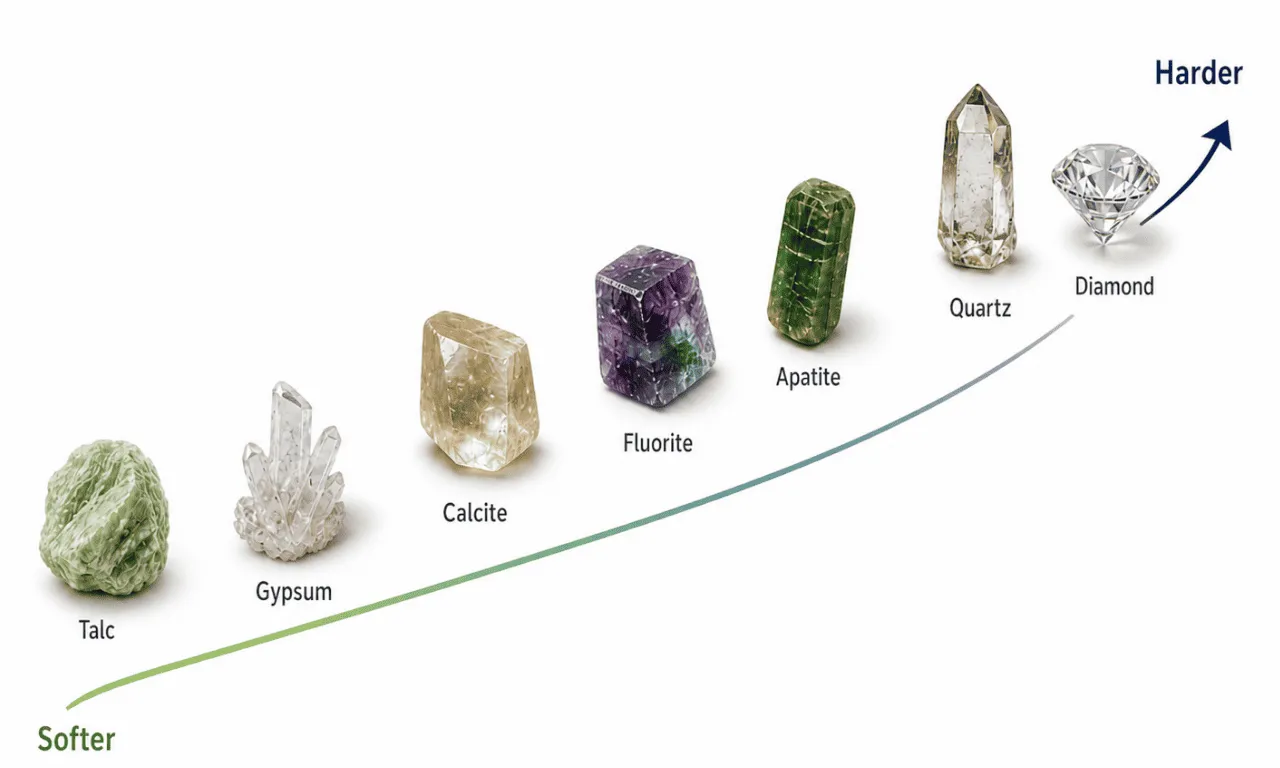
From Talc (1) to Diamond (10): The Complete Reference Chart
The MEKA handbook, on page 126, establishes the complete Mohs reference series. The table below presents each reference mineral with its hardness value, chemical composition, and a typical engineering or everyday context that helps anchor the value in practice.
| Mohs | Mineral | Composition | Notes / Familiar Context |
| 1 | Talc | Mg₃Si₄O₁₀(OH)₂ | Industrial filler; baby powder. Softest reference mineral. |
| 2 | Gypsum | CaSO₄·2H₂O | Plasterboard, drywall. Below fingernail (Mohs 2.5). |
| 3 | Calcite | CaCO₃ | Limestone, marble. Equal to a copper coin. |
| 4 | Fluorite | CaF₂ | Optical lenses, metallurgical flux. |
| 5 | Apatite | Ca₅(PO₄)₃(F,Cl,OH) | Tooth enamel; phosphate ore. Just below a steel knife. |
| 6 | Orthoclase | KAlSi₃O₈ | Major feldspar in granite. Equal to a steel file. |
| 7 | Quartz | SiO₂ | Silica sand; sandstone matrix. Threshold of severe wear. |
| 8 | Topaz | Al₂SiO₄(F,OH)₂ | Gemstone; rare in aggregate feed. |
| 9 | Corundum | Al₂O₃ | Sapphire, ruby, abrasive grit (emery). |
| 10 | Diamond | C | Cutting tool inserts; wire-saw beads. |
Common Objects as Quick Hardness Tests
Because Mohs hardness picks are not always at hand, the handbook (p. 126) lists four everyday objects that operators can use for rapid hardness estimation in the field or laboratory:
| Object | Mohs Hardness |
| Fingernail | 2.5 |
| Copper coin | 3 |
| Steel blade or glass plate | 5.5 |
| Steel file or steel nail | 6 |
Field triage in 30 seconds
If your fingernail leaves a mark, the rock is very soft — gypsum-grade. If a copper coin scratches it but a fingernail will not, you are looking at calcite-grade material such as limestone or marble. If a steel blade scratches the rock but the rock scratches glass, you are between Mohs 5 and 5.5. If the rock readily scratches glass and a steel file, you are in quartz territory or above — and your crusher selection has just narrowed considerably.
Why Mohs Hardness Matters in Aggregate Processing
Crusher Selection by Material Hardness
The single most consequential implication of Mohs hardness in aggregate operations is its influence on crusher type selection. As a working rule:
- Mohs 1–3 (soft): Hammer crushers and soft-stone impact crushers (HSI) operate efficiently. Compression crushers are over-specified for these materials.
- Mohs 4–6 (medium): Jaw, cone, and impact crushers all perform acceptably; selection criteria shift to feed size, throughput, product gradation, and moisture rather than hardness.
- Mohs 7+ (hard): Compression crushing — jaw followed by cone — becomes mandatory for primary and secondary stages. Impact crushers (HSI) wear out far too quickly to be economical, although VSI crushers retain a niche role in tertiary shaping where the chamber is autogenous (rock-on-rock).
These thresholds align with the Wi (Bond Work Index) ranges in the handbook (p. 135): hammer-crushable materials sit at Wi 6–12 kWh/t, while quartzite and granite cluster at Wi 14–22 kWh/t — energy demand that compression chambers handle far more efficiently than impactors.
Wear Part Lifespan and Hardness Correlation
The relationship between Mohs hardness and wear part lifespan is decidedly non-linear. Below Mohs 7, wear scales roughly with the Abrasion Index (Ai) and follows a manageable cost trajectory. At and above Mohs 7, wear life drops sharply because the feed is now harder than carbon steel and approaches the hardness of the chrome and manganese alloys used in liner construction.
The handbook (p. 135) tabulates abrasion indices that bear this out:
- Limestone: Ai 0.001–0.03 (nearly negligible wear).
- Granite: Ai 0.55 ± 0.1 (moderate, hammer-quality wear).
- Quartzite: Ai 0.75 ± 0.1 (severe — quartzite at 90–99 % SiO₂, see also p. 134, ABR 1400–2400 g/t).
For Mohs 7+ feeds, the standard wear part response is high-manganese austenitic steel (Hadfield steel, typically 12–14 % Mn for jaw plates, up to 18–22 % Mn for cone mantles and concaves under heavy impact loading). Hadfield steel work-hardens dramatically under impact, building a wear-resistant case while retaining a tough core. For cone crusher liners on extremely abrasive feeds, white cast irons with 18–22 % Cr offer a secondary path, trading toughness for hardness.

Energy Consumption Implications
Mohs hardness correlates positively, although imperfectly, with the Bond Work Index Wi — the parameter that actually appears in crusher sizing equations. Wi quantifies the kilowatt-hours per tonne required to reduce a rock from a coarse feed size to a target product size; harder rocks invariably push Wi upward.
The Bond third-theory equation:
W = 10 · Wᵢ · ( 1/√P₈₀ − 1/√F₈₀ )
where:
- W = specific energy, kWh/t
- Wi = Bond Work Index, kWh/t (handbook p. 135)
- P₈₀ = product size at 80 % passing, μm
- F₈₀ = feed size at 80 % passing, μm
For aggregate crushing, Mohs hardness is the rapid-field proxy; Wi is the engineering input.
Mohs Hardness of Common Aggregate Rocks
The MEKA handbook tabulates Wi, Ai, density, and UCS for the major aggregate rock types (p. 135) but does not list Mohs values directly. The Mohs ranges in the tables below are drawn from standard mineralogy references; rock-level Mohs is reported as a range because polymineralic rocks reflect the hardness of their dominant mineral phases.
Sedimentary Rocks
| Rock | Mohs | Wᵢ (kWh/t) | Aᵢ | UCS (MPa) |
| Limestone | 3–4 | 12 ± 3 | 0.001–0.03 | 80–180 |
| Sandstone | 6–7 | 10 ± 3 | 0.1–0.9 | 30–180 |
| Dolomite | 3.5–4 | 12 ± 3 | 0.01–0.05 | 50–200 |
| Gypsum (rock) | 2 | n/a | very low | 10–40 |
Limestone and dolomite are essentially calcite-mineral rocks, easily handled by hammer or impact crushers. Sandstone is the deceptive case: although structurally weaker than limestone at the lower end of UCS, its silica grains push Mohs to 6–7 and produce wear behaviour closer to igneous rocks than to other sedimentaries.
Igneous Rocks
| Rock | Mohs | Wᵢ (kWh/t) | Aᵢ | UCS (MPa) |
| Granite | 6–7 | 16 ± 6 | 0.55 ± 0.1 | 200–300 |
| Basalt | 5–6 (often 6) | 20 ± 4 | 0.2 ± 0.1 | 300–400 |
| Gabbro | 6–7 | 20 ± 3 | 0.4 | 170–300 |
| Diabase | 6–7 | 19 ± 4 | 0.3 ± 0.1 | 250–350 |
| Andesite | 5–6 | 16 ± 2 | 0.5 | 170–300 |
Igneous rocks dominate the high-energy, high-wear end of aggregate processing. Granite is variable — 16 ± 6 kWh/t is a notably wide Wi range — because its quartz content varies substantially across deposits. Basalt is exceptionally tough (highest UCS in the handbook table) but its fine-grained texture and lower quartz fraction often keep Mohs nearer 5–6 than 7.
Metamorphic Rocks
| Rock | Mohs | Wᵢ (kWh/t) | Aᵢ | UCS (MPa) |
| Quartzite | 7 | 16 ± 3 | 0.75 ± 0.1 | 150–300 |
| Marble | 3–4 | 12 ± 3 | 0.001–0.03 | 80–180 |
| Gneiss | 6–7 | 16 ± 4 | 0.5 ± 0.1 | 200–300 |
| Schist | 4–6 | — | — | — |
| Silex (Hornfels) | 6–7 | 18 ± 3 | 0.7 | 150–300 |
Quartzite is the worst-case aggregate scenario: ~95 % SiO₂ (handbook p. 134, 90–99 % SiO₂), Mohs 7, Ai 0.75. Marble, by contrast, is recrystallised limestone — Mohs 3–4 — and behaves like a soft-stone application despite its prestige in dimension stone.

Mohs Hardness vs Other Hardness Measures
Mohs vs. Vickers vs. Rockwell — Conversion Approximations
Mohs is an ordinal scale (relative ranking), while Vickers (HV) and Rockwell C (HRC) are absolute scales based on indentation. The approximations below apply to homogeneous metallic-style materials and degrade for layered or anisotropic minerals — but they help bridge mineralogy and metallurgy when discussing wear pairs (rock against liner steel).
| Mohs | Vickers HV (approx.) | Rockwell C (approx.) | Typical Material |
| 1 | ≈ 30 | — | Talc |
| 3 | ≈ 110 | — | Calcite, copper |
| 5 | ≈ 600 | ≈ 50 HRC | Apatite; medium tool steel |
| 6 | ≈ 800 | ≈ 58 HRC | Orthoclase; hardened steel |
| 7 | ≈ 1100 | ≈ 64 HRC | Quartz |
| 8 | ≈ 1400 | off-scale | Topaz |
| 9 | ≈ 2300 | off-scale | Corundum (sapphire/ruby) |
| 10 | ≈ 10 000 | off-scale | Diamond |
Why Engineers Sometimes Use Bond Work Index Instead
When the question is “how much energy will this rock cost to crush?”, the Bond Work Index Wi is the right tool, not Mohs. Wi has units (kWh/t) and plugs directly into Bond’s equation for crusher and mill sizing. Mohs has no units and no equation — it is a triage parameter, useful for screening and crusher-type selection but not for predicting throughput or motor size. In practice, the two are used in tandem: Mohs to pick the crusher family, Wi to pick the model and the drive.
Practical Equipment Selection Guide
Mohs 1–3 (Soft) — Hammer Crushers, Soft-Stone Impact Crushers
Limestone, dolomite, gypsum, and chalk dominate this band. Hammer crushers and soft-stone impact crushers (HSI) deliver the lowest cost per tonne, with a high reduction ratio in a single stage. Wear parts are typically chrome-molybdenum cast steel or 14 % Mn for the most abrasive of the soft stones. UCS values rarely exceed 200 MPa. Energy demand is low (Wi 6–15 kWh/t).
Mohs 4–6 (Medium) — All Crusher Types Suitable
This is the largest band in the aggregate world: most fluorite, apatite, marble (top end), schist, andesite, and softer basalts. Selection is driven by feed size, throughput, gradation requirement, and capex/opex preference rather than hardness alone. A jaw–cone configuration gives the cleanest sizing curve; an impactor delivers the best cubicity for asphalt aggregate; a HSI delivers the lowest capex at the cost of higher wear.
Mohs 7+ (Hard) — Jaw + Cone Mandatory, Limited Impact Use
Quartzite, hard granite, hard sandstone, and gneiss live here. Compression crushing is mandatory: jaw (primary), cone (secondary, tertiary). Wear parts must be 18 % Mn Hadfield steel as a baseline; high-chrome white cast iron (18–22 % Cr) for cone liners on the most abrasive feeds. VSI crushers are the only impact type that survives, and only in autogenous (rock-on-rock) configuration for tertiary cubicity polishing.
| Mohs Range | Recommended Crushers | Wear Part Material | Typical Wᵢ (kWh/t) |
| 1–3 (Soft) | Hammer crusher, HSI (soft-stone impactor) | 14 % Mn / Cr-Mo cast steel | 6–15 |
| 4–6 (Medium) | Jaw, cone, HSI, VSI — all suitable | 14–18 % Mn or high-Cr | 10–18 |
| 7+ (Hard) | Jaw (primary) + Cone (secondary/tertiary), VSI shape | 18 % Mn Hadfield; 18–22 % Cr WCI | 14–24 |
Frequently Asked Questions
What is the Mohs hardness of granite?
Granite typically falls between Mohs 6 and 7. The exact value depends on the relative proportions of quartz (Mohs 7), feldspar (Mohs 6) and accessory minerals (mica at 2.5–3, hornblende at 5–6). Quartz-rich granites behave closer to Mohs 7; alkali- or feldspar-rich varieties closer to Mohs 6. The MEKA handbook (p. 135) reports a Wᵢ of 16 ± 6 kWh/t — that wide ±6 range reflects exactly this compositional variability.
What is the hardest aggregate stone?
Quartzite, at Mohs 7. Its silica content of 90–99 % (handbook p. 134) makes it functionally identical to silica sand consolidated by metamorphism, and its abrasion index Aᵢ ≈ 0.75 (p. 135) is the highest of any common aggregate. Basalt is denser and stronger in compression (UCS 300–400 MPa vs. quartzite’s 150–300 MPa) but is generally softer on the Mohs scale (5–6) because of its lower free-quartz content.
Can I scratch granite with steel?
Marginally, and not reliably. Steel files sit at Mohs 6, granite ranges 6–7. A steel knife will scratch the feldspar phases of granite but will glide off quartz grains. This is exactly the edge case that defines Mohs 6 — the boundary where ordinary tool steel stops being harder than the rock it is trying to cut. For wear part design, this means standard carbon-steel liners are uneconomical on granite feeds; manganese alloys are required.
How does Mohs hardness affect crusher wear?
Non-linearly. Below Mohs 7, wear scales roughly linearly with the abrasion index Aᵢ. At and above Mohs 7, wear life drops sharply because the feed begins to outhardness common alloy steels. The handbook (p. 135) shows the jump clearly: limestone (Mohs 3–4) has Aᵢ 0.001–0.03; granite (Mohs 6–7) has Aᵢ 0.55; quartzite (Mohs 7) has Aᵢ 0.75. Wear part lifespan can fall by an order of magnitude across that band.
What's the difference between Mohs and Vickers hardness?
Mohs is an ordinal scale (1 to 10) measuring relative scratch resistance — it ranks but does not quantify. Vickers (HV) is an absolute scale based on the indentation left by a diamond pyramid under a controlled load, expressed in kgf/mm². Vickers values are linear and additive; Mohs values are not. As a rough conversion: Mohs 7 ≈ HV 1100, Mohs 9 ≈ HV 2300, Mohs 10 ≈ HV 10 000 (see Table 6).
Which crusher is best for hard rock (Mohs 7+)?
A jaw + cone combination is the industry-standard configuration. The jaw handles primary reduction at the lowest specific energy per stage of compression crushing; the cone delivers secondary and tertiary reduction with high capacity and good product gradation. Impact crushers (HSI) are uneconomical above Mohs 7 because the rotor and blow bars wear too quickly. VSI crushers are used in tertiary shaping only, and only in rock-on-rock (autogenous) configuration where the wear surface is rock, not steel.
Is Mohs hardness the same as compressive strength?
No — they measure different physical properties. Mohs hardness measures resistance to surface scratching (a function of mineralogy). Uniaxial Compressive Strength (UCS) measures the maximum compressive stress a rock can sustain before failure, expressed in N/mm² or MPa (handbook p. 125). The two correlate weakly: basalt has low Mohs (5–6) but very high UCS (300–400 MPa), while quartzite has higher Mohs (7) but lower UCS (150–300 MPa). For crusher sizing, both should be considered alongside the Bond Work Index.
MEKA GLOBAL