What Is Aggregate? Types of Aggregate and Areas of Use
What Is Aggregate?
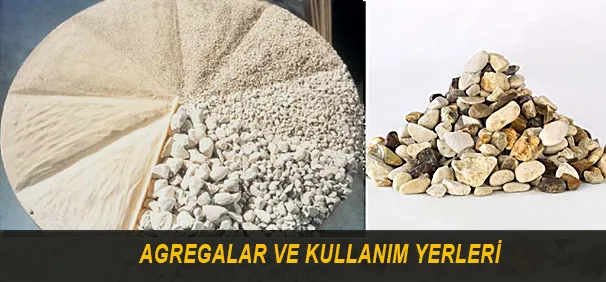
Granular materials of various sizes such as sand, gravel, crushed stone and slag are called aggregate. It is a mass of uncrushed and/or crushed grains of natural, artificial or both types of dense mineral material, in various sizes generally up to 100 mm.
The American standard ASTM D8 defines aggregate as "a granular material of mineral composition, such as sand, gravel, seashell, slag or crushed stone, used either with a binding medium to form mortar or concrete, or alone in applications such as base courses, railroad ballast and similar works."

Types of Aggregate
Aggregates can generally be classified as shown in Table 1. In this article we will focus on the four classification headings most commonly used when selecting aggregates.

Aggregates by Source
Natural Aggregate
Crushed or uncrushed aggregate obtained from mineral sources (rivers, terraces, seas, lakes, quarries and the like) that has undergone no processing other than mechanical processing.

Artificial Aggregate
Aggregate obtained from mineral sources (rivers, terraces, seas, lakes, quarries and the like) that has undergone no processing other than mechanical processing.

Recycled Aggregate
Aggregate obtained by processing inorganic materials that were previously used in structures.

Aggregates by Unit Weight and Specific Gravity
- Aggregates with a specific gravity ≤ 2400 kg/m³ are called lightweight aggregates. Expanded clay, pumice and perlite belong to this class. Concrete produced with these aggregates is called lightweight concrete.
- Aggregates with a specific gravity between 2400 and 2800 kg/m³ are normal-weight aggregates. Sand, gravel, chippings and crushed stone belong to this class. These are simply referred to as aggregate; adjectives such as heavy or light are not used.
- Aggregates with a specific gravity ≥ 2800 kg/m³ are called heavy aggregates. Iron ores such as hematite, magnetite and barite belong to this class. Concrete produced with these aggregates is called heavy concrete.
Aggregates by Grain Shape
Aggregate whose three dimensions are all close to one another is called "rounded (bulky) aggregate." Gravel obtained from riverbeds is generally of this shape.
As with crushed-stone aggregates, aggregates that have protrusions on their grain surfaces caused by the crushing process are defined as "angular aggregate," and the surface of these aggregates is rough.
Flaky aggregate has a shape in which one dimension is very small relative to the other two (similar to a coin).
Elongated aggregate has a shape in which two dimensions are narrow but the length is large (similar to a pencil, pointed).
Flaky and elongated shapes are undesirable properties in aggregates. According to Turkish standards, if the ratio of the largest dimension to the smallest dimension is greater than 3, these aggregate grains are classed as defective grains. In general, worldwide it is not desirable for the defective grains in an aggregate to exceed 10–15%.

Some Methods and Measuring Instruments Used to Determine Grain Shape
The standard used to determine the geometric properties of aggregates in Turkey is TS EN 933 – Tests for Geometrical Properties of Aggregates. To highlight some of the important indices in this standard:
Flakiness Index and Elongation Index – EN 933-3
These indices are important indices relating to how suitable crushed-and-screened aggregate is for use in concrete and road construction.
Figure 6 shows some of the sieve sets used to determine the flakiness index; Figure 7 shows the thickness gauge apparatus.


In the flakiness index sieve sets, they are used, according to the standards, to determine whether the quantity of flaky grains within the aggregate mass is within acceptable limits. If the aggregate grain thickness (smallest dimension) is less than 0.6 times the average of the sieve mesh openings of the grain-size class to which it belongs, the measured aggregate grain is considered flaky. The aggregate sample to be tested is separated into 7 different grain-size classes between 63 mm and 6.3 mm, and each grain class is analysed separately.
Figure 8 shows the elongation measuring apparatus, the Elongation Index Determination Gauge.

The Elongation Determination Apparatus is used, according to the standards, to determine the elongation index in coarse aggregates. If the aggregate grain length (largest dimension) is more than 1.8 times the average of the sieve mesh openings of the grain-size class to which it belongs, the measured aggregate grain is considered longer than normal. The aggregate to be tested is separated into 6 different grain-size classes between 50 mm and 6.3 mm, and each grain class is analysed separately.
Aggregate with a flakiness and elongation index greater than 10–15% is never desirable, whether in concrete or as road aggregate.
Shape Index – EN 933-4
This index expresses the length of coarse aggregate. It is determined with a special micrometer, shown in Figure 9. The upper opening of the micrometer is 1/3 the size of the lower opening. The lower opening is adjusted to the length of the stone piece; if the thickness of the stone piece does not pass through the upper opening it is cubic, and if it does pass through it is not cubic. The determination is made with aggregate ranging in size from 4 mm to 63 mm. In this way each stone piece is classified as cubic or non-cubic.
The shape index is the ratio of the weight of non-cubic pieces to the total weight.

Aggregates by Grain Size
By size, aggregates can be divided into three classes: fine aggregate (sand, crushed stone), coarse aggregate (gravel, crushed stone) and all-in (pit-run) aggregate.

Examining aggregates by size in broader terms, from largest to smallest, aggregates are:

The boundary values separating these groups vary between different classification systems. The classification systems used in Turkey are TS 1500/2000 "Classification of soils in civil engineering," TS EN 13242 + A1, and TS 706 EN 12620+A1 "Aggregates for concrete."
According to TS 1500/2000 among these standards, the general values are given in Table 2.

Determination of aggregate grading in Turkey is carried out according to the standard formerly known as TS 130, now TS EN 933-1:2012. The sets of square-mesh sieves used under this standard are shown in Figure 11. Some of the standards used to determine aggregate properties are given in Table 6.

The square-mesh sieve openings used in aggregate grain classification are shown in Table 3. Intermediate values may be added to or removed from the sieve openings.


Applications of Aggregates
Aggregates, being a fundamental structural material, have many different applications. Particularly in the ready-mixed concrete sector, aggregates make up 60–80% of concrete by volume, and 90–95% by weight and 75–85% by volume of bituminous road pavements. The applications are given in Table 4 and sample images are presented in Figure 12.
Looking at general applications (particularly concrete and asphalt), some of the essential properties sought in aggregates are:
- Aggregates should be hard and sound, resistant to abrasion, should not soften or disintegrate under the effect of water, and should be resistant to freezing.
- They should not form harmful compounds with the components of cement and should not endanger the protection of the reinforcement against corrosion.
- Their grain sizes and distribution should be suitable for the intended use.
- Their shape and surface texture should be good.
- In gravels, the parent rock should have few voids.
- In gravels, as a proportion of foreign matter, soil should not exceed 5%, coal 1%, and clay 0.25% in coarse aggregate and 5% in fine aggregate, while silt should not exceed 1%.


The selection of aggregates must also be made in accordance with the relevant standards, covering aspects such as physical properties and grading distribution. Table 5 gives the aggregate standards used in general applications in Turkey, and Table 6 gives general application examples.


Note:Aggregates must, according to their place of use, meet the properties in the relevant standards and the grain-size distribution (grading). The sizes given here are example values taken from general applications.
MEKA GLOBAL