Rock Types Explained: Igneous, Sedimentary and Metamorphic Rocks in Aggregate Production
Rock Types Explained: Igneous, Sedimentary and Metamorphic Rocks in Aggregate Production
Every aggregate plant on Earth is processing one of three things: a rock formed by cooling molten material, a rock formed by deposition and cementation, or a rock that has been transformed by heat and pressure. The geological label sounds academic, but it is the single most reliable predictor of how that rock will behave when it meets a crusher liner, a screen deck, or a concrete mix design.
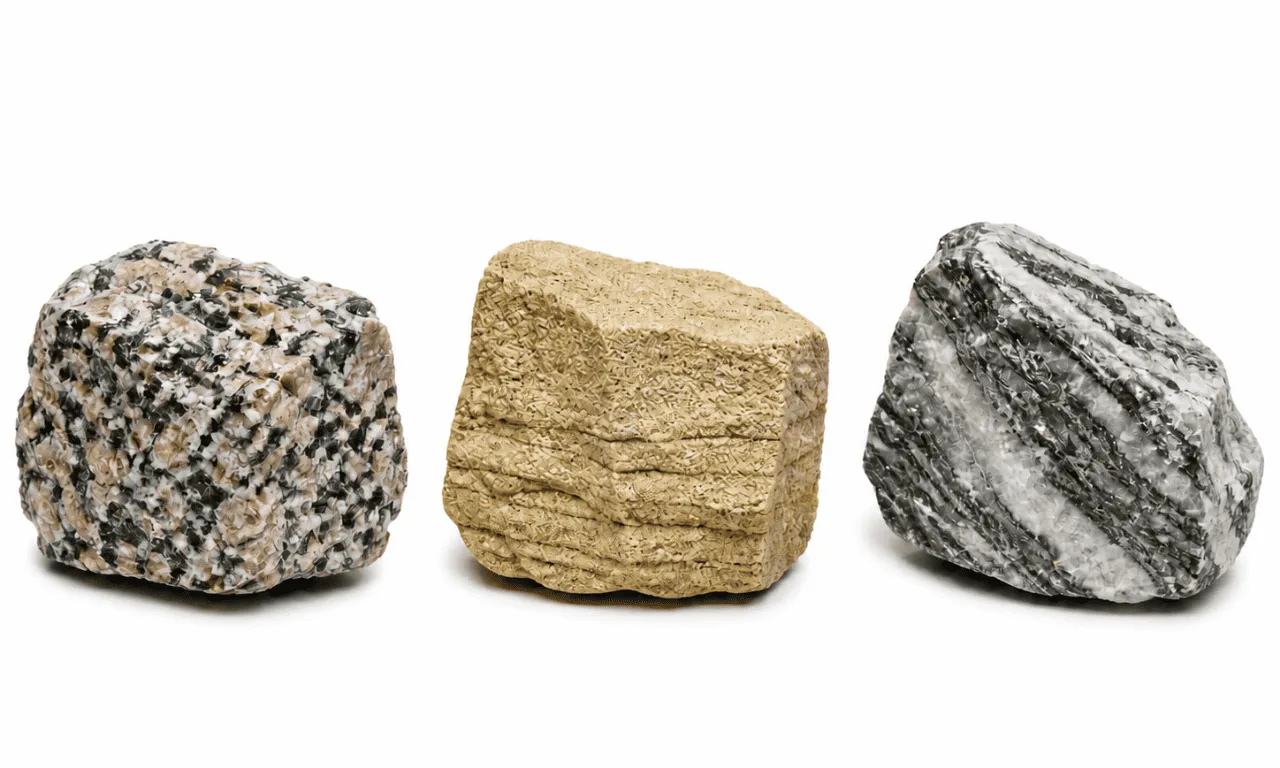
Igneous, sedimentary and metamorphic — these three families differ in formation, mineralogy, hardness, abrasiveness, fracture behaviour and end-use suitability. A granite quarry and a limestone quarry can sit ten kilometres apart and require completely different crushing chambers, wear-part metallurgy and screening media. Misjudge the rock type at the planning stage and you will pay for it in liner consumption, throughput shortfalls and out-of-spec product for the lifetime of the plant.
This guide explains the three rock families from an aggregate-engineering perspective. For each family you get the geological background that explains its properties, the common members you will actually encounter at quarries, the physical characteristics that drive crusher selection, and the typical end uses in construction, concrete and asphalt. The classifications and tables presented here are drawn directly from the MEKA Crushing, Screening and Mining Equipment Handbook, with engineering context added at every step.
The Three Main Rock Types and the Rock Cycle
Geologists divide the rocks of Earth's crust into three primary families based on how they form. The MEKA Handbook identifies four categories of natural-material feed for crushing and screening plants: volcanic (igneous) rocks, sedimentary rocks, metamorphic rocks, and ores. The first three are the rock-forming families that supply almost all aggregate production worldwide; ores are processed in mineral-processing operations, which is a related but distinct discipline.
None of the three families is permanent. A granite intrusion exposed at the surface for millions of years weathers into sand grains that become sandstone — and that sandstone, buried deep enough, can be cooked and squeezed into quartzite. Push the quartzite to greater depth, melt it, and you are back to magma. This continuous transformation between the three states is called the rock cycle, and it is the conceptual backbone of all rock classification.

Why Rock Type Matters in Aggregate Processing
Rock type drives four properties that determine plant configuration. Crushability — the energy required to fracture the rock — varies by an order of magnitude between soft chalk and dense quartzite. Abrasiveness governs how quickly that rock destroys jaw plates, mantles, blow bars and screen media. Fracture behaviour decides whether the rock breaks into cubical aggregate suitable for concrete or splintery flakes that fail flakiness-index limits. Gradation behaviour — how the rock distributes through the size fractions — determines whether you need two crushing stages or four.
These four properties are not independent variables. They are the consequence of how the rock formed. A rock that crystallised slowly at depth has interlocking grains and high abrasion resistance. A rock that precipitated chemically in a warm shallow sea is soft and chemically reactive. A rock that has been folded and re-folded under regional metamorphism inherits planes of weakness from its original layering. Understanding the formation tells you what the rock will do in the plant before you even put a sample through a Bond Work Index test.
The Rock Cycle in Practice
The rock cycle has direct procurement consequences. A quarry described in geological maps as "Cretaceous limestone" might in a particular zone have been recrystallised by a nearby igneous intrusion into low-grade marble. Visually similar, geologically the same parent rock — but the marble will have lower porosity, higher density, and different reactivity in concrete. Always confirm rock identity in the field rather than relying on regional geological labels alone.
Rock Types Explained (Igneous, Sedimentary & Metamorphic)
Igneous Rocks (Volcanic Rocks)
Igneous rocks form when molten material — magma — cools and solidifies, either at the Earth's surface or deep within the crust. They are the original rocks in the rock cycle: every sedimentary and metamorphic rock can ultimately be traced back to an igneous parent. From an aggregate perspective, igneous rocks are the heavyweights of the industry: hard, abrasive, dense, and producing the strongest concrete and ballast aggregates available.
How Igneous Rocks Form
The MEKA Handbook describes the formation pathway clearly: igneous rocks form when molten material (magma) cools on the surface or within the depths of the Earth's crust. They consist of quartz, feldspar, pyroxene, amphiboles, mica, and olivine crystals, primarily derived from silicate melt. The exact mineral composition that crystallises depends on the chemistry of the parent magma — specifically, how much silica (SiO₂) it contains — and on how quickly it cools.
Slow cooling at depth lets crystals grow large and interlocking. Fast cooling at the surface freezes the rock before crystals can develop, producing fine-grained or even glassy textures. This single variable — cooling rate — is what creates the entire range of igneous rock textures you see in quarries.
Surface, Intrusive, and Deep Rocks
Igneous rocks are classified into three subgroups based on where they formed:
- Surface rocks: glass-like or fine-grained textures with grain size below 0.1 mm. These are also called volcanic or extrusive rocks. Basalt is the most common example — most of the world's ocean floor is basalt.
- Intrusive rocks: medium-grained textures with grain size between 0.1 and 2 mm. These rocks cooled in shallow intrusions, dikes and sills — fast enough to keep crystals modest, slow enough to develop a clear crystalline texture. Diabase is the textbook example.
- Deep rocks: coarse-grained textures with grain size above 2 mm. These rocks (also called plutonic rocks) cooled slowly at depth, producing large interlocking crystals visible to the naked eye. Granite is the classic example — its visible quartz, feldspar and mica crystals are unmistakable.
Classification by SiO₂ Content
The other classification axis is silica content. The MEKA Handbook divides igneous rocks into three silica classes, and combining this axis with the cooling-environment axis gives a 3×3 grid that contains every common igneous rock you will encounter at a quarry:
| SiO₂ Content | Deep Rocks | Intrusive Rocks | Surface Rocks |
| Basic (< 52%) | Gabbro | Diabase | Basalt |
| Intermediate (52 – 62%) | Diorite | Porphyry | Andesite |
| Acidic (> 62%) | Granite | Quartz Porphyry | Rhyolite |
Silica content matters for crushing because quartz (pure SiO₂) sits at 7 on the Mohs hardness scale. Acidic rocks — granite, rhyolite — contain visible quartz crystals and are the hardest to crush and the most punishing to wear parts. Basic rocks — gabbro, basalt — have no free quartz and are dominated by softer ferromagnesian minerals, but their dense interlocking texture still makes them tough.

Common Igneous Rocks in Aggregate Production
Three igneous rocks dominate the global aggregate market:
- Granite — the workhorse acidic igneous rock for concrete aggregate, road base, and railway ballast. The Handbook gives granite a Bond Work Index (Wi) of 16 ± 6 kWh/t and a uniaxial compressive strength (UCS) of 200–300 MPa, with abrasion index Ai around 0.55 ± 0.1. Hard, abrasive, and reliable — it produces excellent cubical aggregate when crushed in a properly configured cone or impact crusher.
- Basalt — the heavyweight basic surface rock. UCS 300–400 MPa is among the highest in the Handbook's table, and the dense interlocking texture produces premium-strength concrete and asphalt aggregate. Density of 2.9–3.0 t/m³ also makes basalt the rock of choice for high-modulus concrete and heavy ballast.
- Gabbro — the deep-rock equivalent of basalt, with similar density (2.9–3.0 t/m³) and UCS 170–300 MPa. Often marketed as "black granite" in the dimension-stone industry, it is excellent heavy aggregate.
Sedimentary Rocks
Sedimentary rocks are formed at the Earth's surface, not within it. The MEKA Handbook describes them as the product of physical erosion on the Earth's surface and deposition resulting from chemical dissolution. Wind, water and ice break down existing rocks; the fragments — and any dissolved chemicals — are transported, deposited, and over geological time cemented into solid rock.
Sedimentary rocks supply more aggregate volume than the other two families combined. Limestone alone accounts for the majority of cement raw material and concrete aggregate worldwide. The reason is geological: roughly three-quarters of Earth's land surface is covered by a thin layer of sedimentary rock, and most quarries simply pick the most economic deposit they can find.
How Sedimentary Rocks Form
There are three formation pathways, and the Handbook divides sedimentary rocks accordingly:
Clastic Sedimentary Rocks
Clastic rocks are formed from physical fragments of pre-existing rocks, broken down by mechanical erosion caused by wind, rain and ice. The fragments are transported, sorted by grain size during transport, and deposited in basins, deltas and seafloors. Over time, they are buried, compacted and cemented by groundwater-deposited minerals into solid rock. Examples include breccia (coarse, angular fragments), sandstone (sand-sized grains, the most common clastic), and siltstone (fine-grained, often laminated). Their crushing behaviour is dominated by the strength of the natural cement holding the grains together — strong silica cement gives a tough rock, weak calcite cement gives a friable one.
Chemical Sedimentary Rocks
Chemical sedimentary rocks form not from broken fragments but from dissolved minerals precipitating out of water, typically as warm shallow seas evaporate or as groundwater changes chemistry. The Handbook lists the main chemical sedimentaries as limestone, dolomite, rock salt and gypsum. Of these, limestone is by far the most important for the aggregate industry — it is the principal raw material for cement, the dominant aggregate in concrete worldwide, and the largest single rock product by volume in most national aggregate statistics.
Organic Sedimentary Rocks
Organic sedimentaries form from the accumulated remains of plants and animals — typically marine organisms with calcium carbonate shells. The Handbook lists certain limestones, coal, and some dolomites in this category. Coal is energy feedstock, not aggregate. Organic limestones, however, behave essentially like chemical limestones in the plant: similar hardness, similar reactivity, similar applications.
Sedimentary Rocks in Construction
Three sedimentary rocks dominate the construction-aggregate market:
- Limestone — the most common aggregate raw material globally and the foundation of the cement industry. The Handbook gives limestone a Wi of 12 ± 3 kWh/t, density 2.7 t/m³, UCS 80–180 MPa, and an abrasion index of just 0.001–0.03. That low Ai is the operational headline: limestone is genuinely easy on wear parts.
- Sandstone — widely used as building stone and asphalt aggregate. The Handbook gives sandstone a Wi of 10 ± 3 kWh/t, density 2.7 t/m³, UCS 30–180 MPa (the wide range reflects how variable cementation can be), and abrasion index 0.1–0.9. The abrasion can climb sharply if the cementing matrix is silica-rich.
- Gypsum — a chemical sedimentary used primarily for plaster, drywall and as a setting retarder in cement. Soft (Mohs 2), water-soluble, and far easier to crush than any aggregate-grade rock — but its softness is also why it cannot be used as structural aggregate.
Metamorphic Rocks
Metamorphic rocks are the third family — rocks that started life as something else (igneous or sedimentary) and were transformed by pressure, heat, or both, without ever fully melting. The MEKA Handbook defines them as rocks formed in the Earth's crust through the transformation of volcanic and sedimentary rocks under the influence of pressure and temperature.
The transformation is a solid-state process: minerals reorganise, recrystallise into new minerals stable at the new conditions, and often align themselves perpendicular to the direction of pressure. That alignment — called foliation — is what gives metamorphic rocks like schist and gneiss their characteristic banded or layered appearance, and it has direct consequences for how those rocks fracture during crushing.
Regional vs Contact Metamorphism
The Handbook distinguishes two types of metamorphism by the dominant driver:
- Regional metamorphism — driven by pressure. This is the metamorphism that builds mountain ranges. Entire crustal blocks are squeezed together over millions of years, transforming kilometres of rock at a time. Products are typically foliated (layered or banded) because mineral grains align with the pressure direction.
- Contact metamorphism — driven by temperature. When a hot magma body intrudes into cooler surrounding rock, it bakes the rock immediately around the intrusion, creating a metamorphic aureole. Contact-metamorphic rocks tend to be non-foliated because there is no directional pressure — they recrystallise more uniformly.
Metamorphism Grade Table
Regional metamorphism is further subdivided by intensity, or grade — low, medium and high — reflecting how much pressure and temperature the rock has experienced. The same parent rock produces different metamorphic products at each grade:
| Original (Parent) Rock | Regional — Low Grade | Regional — Medium Grade | Regional — High Grade | Contact Metamorphism |
| Granite | Phyllite | Schist | Schist | Gneiss / Hornfels |
| Basalt | Schist | Amphibolite | Amphibolite | Hornfels |
| Limestone | Marble | Marble | Marble | Marble |
| Sandstone | Schist | Quartzite | Quartzite | Quartzite |

Common Metamorphic Rocks in Aggregate
Three metamorphic rocks see frequent aggregate use:
- Marble — metamorphosed limestone. Wi 12 ± 3 kWh/t, density 2.7 t/m³, UCS 80–180 MPa, abrasion index 0.001–0.03. Crushing behaviour and wear performance are essentially identical to limestone — same parent mineral, same chemistry, just denser and less porous.
- Quartzite — metamorphosed sandstone, recrystallised into a near-monomineralic mass of interlocking quartz. Wi 16 ± 3 kWh/t, density 2.7 t/m³, UCS 150–300 MPa, abrasion index 0.75 ± 0.1 — the highest in the Handbook's main table. Quartzite eats wear parts. It is also one of the best aggregates available for road bases that need to resist polishing under traffic.
- Gneiss — typically a high-grade product of granite metamorphism. Wi 16 ± 4 kWh/t, density 2.7 t/m³, UCS 200–300 MPa, abrasion index 0.5 ± 0.1. Strong, abrasive, and capable of producing premium concrete aggregate — but the foliation can produce flaky particles if crushing is poorly configured.
How to Identify Rock Type in the Field
Aggregate buyers and plant operators rarely have a petrographic microscope on site. The good news: you can identify the rock family — and usually the specific rock — with three field tests that take ten minutes and need only your eyes, a knife or steel nail, and a small bottle of dilute hydrochloric acid (10% HCl).
Visual Inspection Checklist
Start with the unaided eye:
- Texture: Is it massive (no visible structure), foliated (parallel layers or bands), or layered (sedimentary bedding)? Foliation strongly suggests metamorphic. Layering suggests sedimentary. Massive rocks are usually igneous, but can also be contact-metamorphic or chemical sedimentary.
- Grain size: Visible interlocking crystals (>2 mm) suggest deep igneous (granite, gabbro) or coarse metamorphic (gneiss). Crystals you can see but not easily measure suggest intrusive igneous or medium-grade metamorphic. No visible grains at all suggest fine-grained surface igneous (basalt, rhyolite) or fine-grained sedimentary.
- Colour and minerals: Light-coloured rocks (pinks, whites, light greys) are usually quartz-rich and felsic — granite, rhyolite, quartzite, marble. Dark rocks (black, very dark grey, greenish-black) are mafic — basalt, gabbro, amphibolite. Yellow, brown and red rocks are usually sedimentary or weathered.
- Layering vs banding: Sedimentary layering tends to be horizontal, planar, and consists of compositionally distinct beds. Metamorphic banding (foliation) is often folded, with mineral alignment within each band.
Hardness Test
A simple scratch test on the Mohs scale separates many rocks immediately. A steel knife (around 5.5 on the Mohs scale) will scratch limestone, marble, gypsum and most sedimentaries without difficulty. It will not scratch granite, basalt, gneiss or quartzite — those rocks contain quartz or feldspar at hardness 6–7. The Mohs scale itself, established by Friedrich Mohs in 1812 and described in detail in our companion article on the Mohs hardness scale [link to: /blog/mohs-hardness-scale], is the standard reference for relative scratch resistance.
A drop of 10% HCl is the second indispensable test: if the rock fizzes vigorously, it contains calcium carbonate — limestone or marble. If it fizzes only on a freshly powdered surface, it is dolomite. If it does nothing, calcium carbonate is not the dominant mineral.
Density Estimate
Heft a fist-sized sample. A piece of granite at density 2.7 t/m³ and a piece of basalt at 2.9–3.0 t/m³ are noticeably different in the hand. Pumice floats. Iron ore feels conspicuously heavy. For systematic measurement methods, see our companion article on the physical properties of rocks [link to: /blog/physical-properties-of-rocks].
Rock Type and Crusher Selection
The ultimate test of rock-type knowledge is configuring the crushing plant. Each family imposes different demands on the equipment.
Why Igneous Rocks Wear Crushers Faster
Acidic igneous rocks — granite, rhyolite, quartz porphyry — contain free quartz at Mohs 7. Basic igneous rocks — basalt, gabbro — are dense and tough even without free quartz. Both groups push abrasion indices above the comfort zone of standard wear materials. Manganese cast steel becomes mandatory for jaw plates and cone crusher mantles. Wi values around 16–20 kWh/t mean higher installed power and slower throughput per kilowatt than softer feeds. The Handbook's table puts basalt at Wi 20 ± 4 and UCS 300–400 MPa, gabbro at Wi 20 ± 3, and granite at Wi 16 ± 6 — all firmly in the high-energy crushing category. For these feeds, MEKA recommends jaw crushers with high-manganese liners for primary stage [link to: /products/crushing-screening-plants/crushers/jaw-crusher] and cone crushers for hard volcanic rocks at secondary and tertiary stages [link to: /products/crushing-screening-plants/crushers/cone-crusher].
Sedimentary Rocks: Easy Crushing, Variable Quality
Limestone, dolomite and most sandstones are far more forgiving. The Handbook gives limestone Wi 12 ± 3 and abrasion index 0.001–0.03 — wear-part life is measured in months, not weeks, and the lower energy requirement opens up impact-crusher solutions that are uneconomic for harder feeds. Impact crushers also produce excellent cubical product from limestone, often eliminating a tertiary crushing stage. The catch is variability: a single quarry can contain massive, well-cemented limestone in one zone and friable, high-clay limestone in another. Material characterisation across the deposit is essential before committing to plant configuration.
Metamorphic Rocks: Special Considerations
Metamorphic rocks split into two distinct camps. Marble is essentially limestone with better mechanical properties — same chemistry, same crushing behaviour, just denser. Quartzite is sandstone taken to its extreme: pure interlocking quartz, the most abrasive aggregate-grade rock in routine commercial use. The Handbook's abrasion index of 0.75 ± 0.1 for quartzite is roughly 25 times that of limestone.
Foliated metamorphic rocks — schist, slate, phyllite, some gneisses — bring an additional concern: anisotropy. The rock is mechanically weaker along the foliation than across it, and it preferentially fractures along that plane. The result is an elongated, flaky particle shape that can fail flakiness-index limits for concrete and asphalt. Crushing chamber selection matters more here than for any other rock family. Compression crushers (jaw, cone) tend to amplify the flakiness; impact crushers, which break by repeated impacts in random orientations, generally produce more cubical product from foliated rocks.
Rock Type Comparison: Three Families at a Glance
The table below summarises the three rock families across eight engineering attributes. Numerical values are drawn from the MEKA Handbook's physical-properties table for representative rocks in each family; site-specific values should always be confirmed by laboratory testing of actual feed.
| Attribute | Igneous | Sedimentary | Metamorphic |
| Formation | Cooling of magma at surface (volcanic) or at depth (plutonic) | Erosion, deposition and cementation of fragments or precipitates | Solid-state transformation of igneous or sedimentary parent under heat / pressure |
| Density (Solid, t/m³) | 2.7 – 3.0 (granite 2.7; basalt/gabbro 2.9 – 3.0) | 2.7 (typical limestone, sandstone, dolomite) | 2.7 – 3.0 (marble 2.7; amphibolite 2.8 – 3.0) |
| Hardness (Mohs) | 6 – 7 (quartz/feldspar dominated for acidic rocks) | 3 – 7 (limestone ~3; sandstone variable, often 6 – 7) | 3 – 7 (marble ~3; quartzite ~7; gneiss 6 – 7) |
| Common members | Granite, basalt, gabbro, diorite, andesite, rhyolite, diabase, porphyry | Limestone, dolomite, sandstone, breccia, gypsum, rock salt, organic limestone | Marble, quartzite, gneiss, schist, amphibolite, phyllite, hornfels |
| Crushability (Wi, kWh/t) | Hard. Granite 16 ± 6; basalt 20 ± 4; gabbro 20 ± 3 | Easy to medium. Limestone 12 ± 3; sandstone 10 ± 3; dolomite 12 ± 3 | Medium to hard. Marble 12 ± 3; quartzite 16 ± 3; gneiss 16 ± 4 |
| Abrasion Index (Ai) | High. Granite 0.55 ± 0.1; basalt 0.2 ± 0.1; gabbro 0.4 | Low. Limestone 0.001 – 0.03; dolomite 0.01 – 0.05; sandstone 0.1 – 0.9 | Variable. Marble 0.001 – 0.03; quartzite 0.75 ± 0.1; gneiss 0.5 ± 0.1 |
| Typical applications | High-strength concrete, road base, ballast, dimension stone | Cement raw material, concrete aggregate, asphalt aggregate, plaster (gypsum) | Decorative stone, polished surfaces (marble), high-friction road wearing course (quartzite) |
| MEKA crusher recommendation | Jaw crusher (primary) + cone crusher (secondary/tertiary), Mn-steel liners | Jaw + impact crusher, or impact-only for soft limestone; standard liners suffice | Match parent rock: marble → impact; quartzite → cone with hard liners; foliated → impact for cubicity |
Frequently Asked Questions
What's the difference between igneous and metamorphic rocks?
Igneous rocks form by cooling and crystallisation of magma — they have never been any other kind of rock. Metamorphic rocks were originally igneous or sedimentary and have been transformed by heat and pressure without melting. The simplest visual cue: most metamorphic rocks show foliation (parallel banding or layering of mineral grains), while igneous rocks tend to be massive with randomly oriented crystals. Granite (igneous) and gneiss (often a high-grade metamorphic product of granite) can have nearly identical mineralogy, but the gneiss will show banding the granite does not.
What rocks are best for road construction aggregates?
It depends on the road layer. For wearing courses that need polish resistance under traffic, hard angular aggregates are preferred — granite, basalt, and especially quartzite. For base courses and sub-base, where strength matters more than polish resistance, limestone and dolomite are widely used and far more economical. Asphalt mixes typically blend a hard aggregate with a softer one to balance stability and workability.
Is granite igneous or metamorphic?
Granite is igneous — specifically, an acidic deep (plutonic) rock that crystallised slowly from magma at depth. The confusion arises because gneiss, a high-grade metamorphic rock, often forms from granite and looks similar. The distinguishing feature is foliation: gneiss has visible banding or alignment of minerals, granite does not.
Why are some rocks harder to crush than others?
Two factors dominate. First, mineral hardness — rocks containing quartz (Mohs 7) and feldspar (Mohs 6) are harder than rocks dominated by calcite (Mohs 3) or gypsum (Mohs 2). Second, the strength of the bonding between grains — interlocking crystalline rocks like granite and basalt are tougher than cemented sedimentaries like sandstone, even at similar grain hardness. The Handbook quantifies this with the Bond Work Index (Wi): basalt at Wi 20 ± 4 kWh/t requires roughly twice the crushing energy of sandstone at Wi 10 ± 3 kWh/t.
What is the most common rock type used in concrete?
Limestone — globally the dominant aggregate in concrete by tonnage, and also the principal raw material for the cement that binds the concrete. Crushed granite, basalt and dolomite are also widely used; the choice depends primarily on what is locally available, since aggregate transport costs scale rapidly with distance.
How does rock formation affect aggregate quality?
Strongly. Foliated metamorphic rocks (slate, schist, phyllite) tend to fracture into elongated, flaky particles that can fail concrete flakiness-index limits — a direct consequence of the parallel mineral alignment created during regional metamorphism. Sedimentary rocks vary in cementation across a single deposit, so quality control over a working face matters more than in massive igneous quarries. Massive igneous rocks like granite and basalt are the most consistent feeds, which is why they remain the gold standard for high-specification structural aggregate.
MEKA GLOBAL