Physical Properties of Rocks: A Reference Guide for Engineers
Physical Properties of Rocks: A Reference Guide for Engineers
Every crushing plant decision — chamber selection, liner alloy, motor sizing, screen aperture, conveyor belt class — traces back to a small set of physical properties of the rock being processed. Density tells you how the material will load a feeder. Hardness predicts how a manganese steel jaw plate will wear. The Bond Work Index (Wi) translates feed-to-product reduction into kilowatt-hours per tonne. Los Angeles abrasion loss (LA) signals whether an aggregate will hold up in a wearing course or crumble before commissioning.
This reference consolidates the eight rock characteristics that govern crusher sizing, wear-part selection and aggregate qualification, drawing directly on test methods and value ranges set out in international standards — ASTM C131, EN 1097-2, EN 933-4, ASTM D 7625-10 and the French P18-579 LCPC procedure. Each property is presented with its definition, the standard test that produces it, the formula behind the result, and a typical range for the rocks engineers encounter in quarrying, mining and aggregate production.
The Master Reference Table at the end of this guide consolidates Bond Work Index, density, bulk density, abrasion index, LA loss and uniaxial compressive strength for more than twenty common rocks — the same dataset used by MEKA application engineers when sizing crushing and screening equipment.
The Eight Key Physical Properties of Rocks
Eight measurable physical properties drive virtually every engineering decision in a crushing and screening circuit. They are summarised below; each is examined in detail later in this guide.
| Property | Symbol | What it tells you | Unit |
| Hardness (Mohs Scale) | — | Relative scratch resistance of a mineral | 1–10 scale |
| Specific Gravity (Solid Density) | ρₛ | Density of the solid rock material | t/m³ |
| Bulk Density | ρᵇ | Density of the loose, compacted aggregate heap | t/m³ |
| Crushability | CR | Percentage indicating how easily a rock is crushed | % |
| Abrasiveness | ABR | Wear caused by the rock on a reference plate | g/t |
| Abrasion Index | Aᵢ | Indicator of the rock's abrasion strength | — |
| Los Angeles Abrasion Loss | LA | Mass loss in a standardised tumbling test | % |
| Bond Work Index | Wᵢ | Energy required for size reduction | kWh/t |
| Uniaxial Compressive Strength | UCS | Maximum compressive stress before failure | N/mm² (MPa) |
| Flatness / Length Index | IF, IL | Cubicity and elongation of crushed aggregate | % |
Why Engineers Need These Values
Plant designers use the Bond Work Index to estimate the connected motor power per tonne of throughput, then layer in a safety factor and a drive efficiency to size the crusher motor. Wear-part engineers translate the Abrasion Index into a lifespan factor — directly determining how often a jaw plate, blow bar or cone mantle needs to be replaced. Aggregate producers rely on LA loss, flatness index and shape index to qualify their product for concrete, asphalt or unbound base layers under EN, ASTM and DIN specifications.
Skipping these tests, or relying on values from a similar-looking quarry, is a common cause of underpowered crushers, premature wear-part failure and rejected aggregate batches. Where a property cannot be measured in a laboratory at the start of a project, the typical ranges in the Master Reference Table below provide the next-best engineering estimate.
Physical Properties of Rocks
Hardness (Mohs Scale)
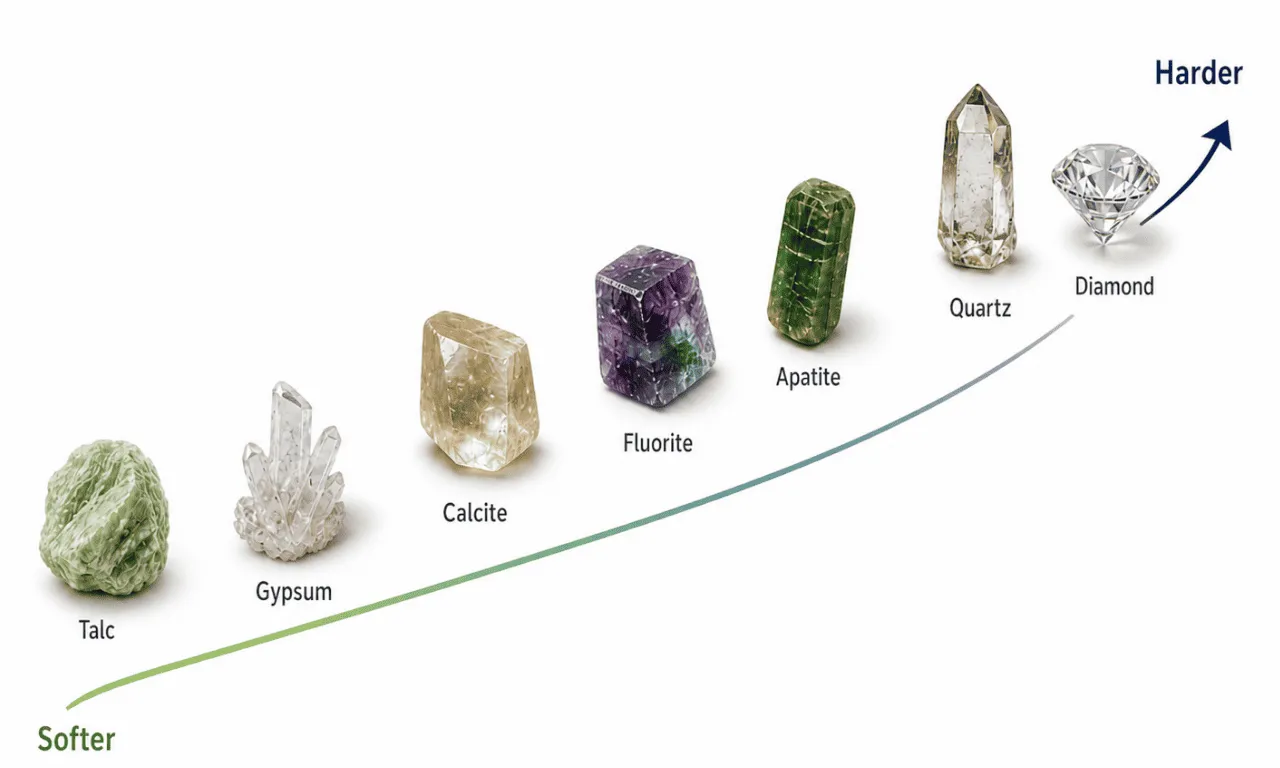
Hardness, in the rock mechanics context used for crusher sizing, is the relative resistance of a mineral to scratching. The standard scale was established in 1812 by the German mineralogist Friedrich Mohs and ranks ten reference minerals from talc (1) to diamond (10). Every rock-forming mineral can be located on this scale, and the dominant mineral typically determines the abrasive behaviour of the rock as a whole.
Quick Reference — Mohs Scale
Common field references for quick scratch testing:
- Fingernail hardness ≈ 2.5
- Copper coin hardness ≈ 3
- Steel blade or glass plate hardness ≈ 5.5
- Steel file or steel nail hardness ≈ 6
| Mineral | Mohs Hardness |
| Talc | 1 |
| Gypsum | 2 |
| Calcite | 3 |
| Fluorite | 4 |
| Apatite | 5 |
| Orthoclase | 6 |
| Quartz | 7 |
| Topaz | 8 |
| Corundum | 9 |
| Diamond | 10 |
Because Mohs hardness is ordinal — not linear — the difference between corundum (9) and diamond (10) is far larger than between fluorite (4) and apatite (5). For quantitative wear prediction, engineers use the Abrasion Index Ai (see Abrasiveness Tests below), not Mohs alone. For a full treatment of Mohs hardness and its relationship to the Vickers scale, see [link to: /blog/mohs-hardness-scale].
Specific Gravity and Bulk Density
Two distinct density values appear in every rock data sheet, and they are routinely confused. Solid density (specific gravity) describes the rock material itself; bulk density describes a heap of crushed aggregate. Both are reported in tonnes per cubic metre (t/m³), but they answer different engineering questions.
Specific Gravity (Solid Density): Definition and Units
Specific gravity — also called solid density — is the ratio of the weight of a solid to its volume, with no air voids included. It is expressed in t/m³ (numerically equal to g/cm³ and to specific gravity referenced to water at 4 °C). For typical silicate rocks, solid density falls between 2.6 and 3.0 t/m³. Iron ores such as hematite and magnetite reach 5.1–5.7 t/m³ because of their high iron content.
Bulk Density: Measurement Method
Bulk density is the weight of a unit volume of aggregate — not solid rock, but a heap of crushed material with air voids between particles. The standard procedure dries the aggregate at 110 °C until it is segregation-free, then fills a clean container of known volume V to the brim. The excess is struck off with a straight-edged board, the container is weighed, and bulk density is calculated as the ratio of aggregate mass to container volume.
Why the Two Differ
Bulk density is always lower than solid density for the same rock because of the air voids between particles. The ratio between the two is governed by three factors: porosity (intrinsic void volume of the rock), particle shape (spheres pack at ≈64 % whereas elongated chips pack lower), and particle size distribution (well-graded mixes pack tighter than single-size chips). For most quarried aggregates, bulk density is 1.5–1.8 t/m³ while solid density of the same rock is 2.6–3.0 t/m³ — the difference is the air.
Bulk density determines how much material a feeder, bin or conveyor will actually move — not the solid density. Sizing a stockpile or a silo on solid density alone overstates capacity by 35–40 %.
Crushability (CR)
What CR Tells You
Crushability (CR) is a percentage that indicates how easily a rock can be reduced in size. It is determined together with the LCPC abrasiveness test (described below) and reported as the friability percentage — the proportion of the original test sample that passes a 1.6 mm sieve after 5 minutes of impact in the LCPC apparatus.
A higher CR value means the rock breaks more readily under impact — useful information when selecting between crusher types (impact crushers favour high-friability rocks; jaw and cone crushers handle the full range). Friability is grouped into four classes:
| Friability (%) | Friability Class |
| 0–25 | Low |
| 25–50 | Medium |
| 50–75 | High |
| 75–100 | Very high |
Abrasiveness Tests
Abrasiveness measures the wear that a rock inflicts on a reference test piece. Three tests are routinely used in the crushing and tunnelling industries, each developed in a different region and each measuring slightly different aspects of the same underlying behaviour. They are not interchangeable, and a complete rock characterisation often reports all three.
ABR — LCPC Abrasivity Coefficient (P18-579)
The LCPC test was developed by the Laboratoire Central des Ponts et Chaussées and is governed by French standard P18-579. It produces both the LCPC Abrasivity Coefficient (ABR, in g/t) and the friability index (CR, %) in a single 5-minute test.
The testing apparatus consists of a rotor that holds a test plate approximately 25 mm × 50 mm in size and 5 mm in thickness, with a Brinell hardness of approximately 60–75. The plate is used for measuring abrasiveness and friability. The material to be tested is placed in a container measuring Ø90 × 100 mm. Within the container, 500 grams of material in the size range of 4–6.3 mm is placed.
The test plate is rotated at a speed of 4500 rpm for 5 minutes. After this duration, the material inside the container is emptied and sieved through a test sieve with a gap of 1.6 mm. The test piece and the material sieved through 1.6 mm are then weighed.

The LCPC Abrasivity Coefficient is then calculated as:
ABR = (m0 − m) / M
Where:
- ABR: LCPC Abrasivity Coefficient, g/t
- m0: Weight of the test plate before the test, grams
- m: Weight of the test plate after the test, grams
- M: Weight of the material subjected to the test, 0.00005 tons
The friability index (CR) is calculated from the same test as:
CR (%) = (M1.6 / M) × 100
- M1.6: Weight of material sieved through the 1.6 mm sieve, grams
- M: Weight of material subjected to the test, grams
Cerchar Abrasivity Index (CAI) — ASTM D 7625-10
The Cerchar Abrasivity Index is determined by fixing the rock sample tightly in a clamp. A heat-treated alloy steel tip, with a 7 kg dead weight on a 90° conical needle-shaped pin, is lowered onto the sample. The needle is moved 10 mm over the sample within a 1.5 second period.
The diameter of the worn tip is measured precisely under a microscope in terms of 1/10th of mm. The Cerchar Abrasivity Index is then calculated as:
CAI = 10 × d
Where:
- CAI: Cerchar abrasion index
- d: Diameter of the wear flat, mm
The hardness of the pin should be 54–56 Rockwell C. For accurate measurements, 5 measurements should be taken with 5 pins. The CAI is widely used in mechanised tunnelling — it correlates strongly with disc cutter wear in TBM operations — and as a quick laboratory cross-check on LCPC results.

Abrasion Index (Aᵢ) and Friability Class — Reference Table
Combining the LCPC and Cerchar approaches, the table below groups common rock classes by abrasion resistance level, friability class and corresponding friability range. It is the quickest way to estimate the duty class of a feed material in the absence of laboratory data.
| Material Type | Abrasion Resistance Level | Friability class | Friability |
| Wood | Non-abrasive | 0.0–0.3 | 0–50 |
| Clay, Siltstone | Very slightly abrasive | 0.3–0.5 | 50–100 |
| Pure Marble | Slightly abrasive | 0.5–1.0 | 100–250 |
| Limestone, Marble with SiO₂ | Abrasive | 1.0–2.0 | 250–500 |
| Quartz, Sandstone, Basalt | Highly abrasive | 2.0–4.0 | 500–1250 |
| Quartz, Granite, Gneiss | Very highly abrasive | 4.0–6.0 | 1250–2000 |
How to Use Aᵢ for Wear-Part Lifespan Prediction
For a more accurate calculation of the worn jaw and side liner lifespans in jaw and cone crushers, a lifespan factor of L1 = 1 is taken to correspond to an abrasion index of 0.5. The chart below — derived from field data on common quarry rocks — plots the lifespan factor (Lf) against the rock's abrasion index (Ai).

Reading the chart for a representative selection of rock types:
| Material | Abrasion Index Ai | Life Factor Lf |
| Limestone | 0.001–0.015 | 5–15 |
| Dolomite | 0.01–0.05 | 5–10 |
| Basalt | 0.20 ± 0.09 | 2 |
| Diabase | 0.30 ± 0.10 | 1.5 |
| Gneiss | 0.50 ± 0.10 | 1.0 |
| Granite | 0.55 ± 0.11 | 0.9 |
| Highly abrasive material | 0.75 ± 0.12 | (0.25–0.5) |
| Extreme abrasive (quartzite-rich) | > 1 | 0.15 |
A limestone wear part might run 5–15 times the reference life of the same component in a granite quarry. This factor feeds directly into spare-part stocking, planned maintenance windows and total cost of ownership calculations.
Los Angeles Abrasion Loss (LA)
Los Angeles abrasion loss is the most widely specified single number in aggregate qualification. It appears in highway specifications, railway ballast standards and concrete aggregate codes worldwide. The test method applied to rocks is determined by ASTM C131 and EN 1097-2.
Test Method
The test device consists of a cylinder with an inner diameter of Ø711 mm and a length of 508 mm, rotating at a speed of 30–33 rpm. The axis of the cylinder is in a horizontal position. Inside the cylinder, there is one shelf with a thickness of 25 mm and a height of 90 mm. The purpose of this shelf is to lift the material and steel balls to a certain height, ensuring their fall.
Inside the cylinder, steel balls with a diameter of Ø48 mm and a quantity ranging from 6 to 12, depending on the gradation of the test material, are charged with 5000 g of test material. After rotating the cylinder 500 times, the contents are emptied into a tray. After separating the balls, the test material is sieved through a sieve with an opening of 1.70 mm. The material remaining on the sieve is dried and weighed.


LA Formula
The Los Angeles abrasion loss is calculated as:
LA = (5000 − G) / 50
Where:
- LA: Los Angeles Abrasion Loss, %
- G: Weight of rocks remaining above the 1.70 mm sieve, measured in grams
Typical LA Values for Common Rocks
Specifications for high-traffic asphalt wearing courses commonly require LA ≤ 25 %; concrete aggregates typically allow LA ≤ 35–40 %. Indicative ranges from the MEKA database:
| Rock | Typical LA Loss (%) |
| Basalt | 8–21 |
| Diabase | 7–34 |
| Quartzite | 17–30 |
| Granite | 17–35 |
| Gneiss | 15–28 |
| Diorite | 14–30 |
| Gabbro | 14–30 |
| Limestone | 30–45 |
| Sandstone | 15–55 |
| Dolomite | 15–55 |
Basalt and diabase, with their tightly interlocked fine-grained matrices, sit firmly inside the strictest highway specifications. Limestone and dolomite — the workhorses of cement and base aggregate production — cluster around the threshold for unbound layers and require careful source selection for asphalt use.
Bond Work Index (Wᵢ)
Of all the values in this guide, none affects equipment selection more directly than the Bond Work Index. Developed by Fred C. Bond at the Allis Chalmers test centre and accepted worldwide, the Bond Work Index is the indicator showing the energy required to perform a crushing operation.
What Wᵢ Measures
The Bond Work Index (Wᵢ) expresses, in kilowatt-hours per ton (kWh/t), the work input required to reduce a rock from a theoretically infinite particle size down to 80 % passing 100 microns. The Bond formula uses Wᵢ to estimate the actual energy required to crush a given feed to a given product size, which is then translated directly into installed motor power.
The Bond Test Setup
30 cubically shaped rocks are needed for the test. These rocks will pass through a 70 × 70 mm square mesh but will not pass through a 55 × 55 mm square mesh. The rock is placed on the anvil between two pivoting hammers; the hammers are released from increasing heights until the rock breaks. The lifting distance at the moment of breakage records the impact energy absorbed by the rock.

Bond's Crushing Formula
The Work Index (Wᵢ) is an indicator of the rock's breakability. It is also used in calculating the energy required for breaking, employing the Bond Formula:
W = 11 · Wi · (1 / √P80 − 1 / √F80)
Where:
- W: Approximate specific energy requirement for crushing, kWh/t
- Wᵢ: Bond Work Index, kWh/t
- P₈₀: Square mesh size through which 80 % of the product (material from the crusher) passes, in microns
- F₈₀: Square mesh size through which 80 % of the material fed to the crusher passes, in microns (fine material should be screened out from the fed material)
If the fine material has not been screened out from the fed material, the corrected F value should be considered. The corrected F value is calculated as follows:
Fc = ((Fmax + Fmin) / 2) × 1000
Where:
- Fₘₐₓ: Maximum size of the fed material, mm
- Fₘᵢₙ: Minimum size of the fed material, mm
- Fc: Corrected feed size, microns

Calculating Wᵢ from Test Data
If only the impact-test data are available, the Work Index can be back-calculated from the energy absorbed at fracture and the rock's specific gravity:
a = 2 · G · h / c
Where:
- a: Impact strength, kgm/cm
- G: Weight of each hammer, kg
- h: Lifting distance of hammers at the moment when the material is broken, m
- c: Smallest dimension of the test material, cm
Wᵢ is then calculated as:
Wi = 47.6 × (a / d)
Where:
- a: Impact strength, kgm/cm
- d: Specific gravity of the rock, gr/cm³
The Bond formula is used for both the impact work index and the grinding work index, with appropriate test apparatus for each.
How Wᵢ Affects Crusher Sizing and Energy Costs
Multiplying the calculated specific energy W (kWh/t) by the design tonnage gives the total power required at the crushing chamber. After accounting for drive losses and a safety factor, that becomes the installed motor power. A 4 kWh/t rock at 500 t/h needs 2000 kW at the chamber; a 7 kWh/t rock at the same tonnage needs 3500 kW — the same throughput, 75 % more electricity bill.
For a worked example of how Wᵢ feeds into chamber sizing and motor selection, see
[link to: /blog/crusher-capacity] (energy calculation in crusher sizing).
Uniaxial Compressive Strength (UCS)
Test Method and Formula
Cylindrical rock samples with a length of at least 2 times the diameter are used to determine the compressive strength of the rock. The sample is subjected to low-speed pressure, and the breaking load is determined.
UCS = F / A
Where:
- F: Breaking force of the sample, N
- A: Cross-sectional area of the sample, mm²
- UCS: Compressive strength, N/mm² (= MPa; 1 MPa ≈ 145 psi)
Typical UCS Ranges
UCS is the headline number for rock mechanics in mining and tunnelling. For aggregate production it is a useful indirect indicator of crushability and wear behaviour. Typical ranges from the Master Reference Table:
| Rock | UCS (MPa) | UCS (psi, approx.) |
| Basalt | 300–400 | 43,500–58,000 |
| Diabase | 250–350 | 36,300–50,800 |
| Granite | 200–300 | 29,000–43,500 |
| Gneiss | 200–300 | 29,000–43,500 |
| Andesite | 170–300 | 24,650–43,500 |
| Quartzite | 150–300 | 21,750–43,500 |
| Limestone | 80–180 | 11,600–26,100 |
| Marble | 80–180 | 11,600–26,100 |
| Sandstone | 30–180 | 4,350–26,100 |
| Dolomite | 50–200 | 7,250–29,000 |
Flatness Index (IF) and Length Index (IL)
Why Cubic Aggregate Matters
The flatness index and length index are crucial for the usability of crushed and screened aggregates in concrete and road construction. Flat, elongated particles align flat-side-down under compaction, leaving voids and reducing interlocking. They reduce concrete workability, lower asphalt density, and shed easily under wheel loading in unbound base layers.
An aggregate with a flatness or length index exceeding 10–15 % is never desirable in either concrete or road aggregates. This is the threshold against which a quarry's chamber selection and closed-side setting should be tuned.
Determination Tables
The flatness and length indices are determined separately, but on the same fractionated sample. Each element of the aggregate prepared for the purpose of determining the length index is separated from the corresponding passers and non-passers through the relevant window of the determination table. If the total sample aggregate weight is M₂, the weight of samples not passing through the pin intervals of the relevant length index determination table is M₄, and the weight of sample aggregate passing through the window intervals is M₃, the indices are calculated as:
IL = Length index (%) = (M4 / M2) × 100
IF = Flatness index (%) = (M3 / M2) × 100
The required sample sizes for each fraction are:
| 100% passing size (mm) | 100% retained size (mm) | Flat index slot gap (mm) | Minimum quantity (kg) |
| 63 | 50 | 33.9 | 50 |
| 50 | 37.5 | 26.3 | 35 |
| 37.5 | 28 | 19.7 | 15 |
| 28 | 20 | 14.4 | 5 |
| 20 | 14 | 10.2 | 2 |
| 14 | 10 | 7.2 | 1 |
| 10 | 6.3 | 4.9 | 0.5 |
| 100% passing size (mm) | 100% retained size (mm) | Length index gauge between pins (mm) | Minimum quantity (kg) |
| 50 | 37.5 | 78.7 | 35 |
| 37.5 | 28 | 59 | 15 |
| 28 | 20 | 43.2 | 5 |
| 20 | 14 | 30.6 | 2 |
| 14 | 10 | 21.6 | 1 |
| 10 | 6.3 | 14.7 | 0.5 |

Quality Threshold
Concrete and road aggregates with combined flatness and length indices above 10–15 % consistently underperform on workability and density. When site testing returns values above this threshold, the typical interventions are: tighter closed-side setting, choke feeding, retrofit of an autogenous rock-on-rock chamber (vertical shaft impactor), or addition of a tertiary cubicising stage.
Shape Index (Iₛ) — EN 933-4
The Caliper Method
The shape index, governed by EN 933-4, is an index that indicates whether the coarse aggregate is cubic. It is determined with a special caliper (see below).

The upper opening of the caliper is one-third of the lower opening. The lower opening of the caliper is adjusted according to the length of the stone piece. If the thickness of this stone piece is exceeded, it is not cubic. The test is performed with aggregates ranging in size from 4 mm to 63 mm. In this way, each stone piece is classified as cubic or non-cubic.
Cubic vs Non-cubic Classification
The shape index is the percentage of the non-cubic piece weight to the total weight:
Is = (mass of non-cubic particles / total mass) × 100
EN 933-4 reports the shape index as a percentage; a lower value indicates a more cubic, higher-quality aggregate. Concrete specifications typically require Iₛ ≤ 20–40 % depending on application class — verify in the project's binding specification.
The Master Reference Table — Properties of 20+ Common Rocks
The two tables below consolidate the physical property dataset from the MEKA Handbook (pp. 134–135). The first table provides the SiO₂ content, Wi, crushability, LA loss and ABR for thirteen rocks; the second adds rock type, density, bulk density, abrasion index and uniaxial compressive strength for twenty-one rocks. Together they cover the rocks most often encountered in aggregate, mining and industrial mineral applications.
Table A — SiO₂, Wi, Crushability, LA Loss, ABR
| Rock Name | SiO₂ (%) | Wᵢ Work Index | Breakability / Crushability CR (%) | LA Abrasion Loss | ABR (g/t) |
| Amphibolite | — | 16–19 | 25–46 | — | 300–1600 |
| Basalt | 20–50 | 10–20 | 20–44 | 8–21 | 500–2300 |
| Diabase | 45–55 | 14–22 | 18–44 | 7–34 | 450–2300 |
| Diorite | 55–70 | 10–22 | 20–36 | 14–30 | 400–1700 |
| Dolomite | 0–10 | 6–12 | 30–56 | 15–55 | 20–450 |
| Gabbro | 40–55 | 8–22 | 27–34 | 14–30 | 800–1700 |
| Gneiss | 55–75 | 11–18 | 30–67 | 15–28 | 600–1600 |
| Granite | 65–75 | 10–20 | 28–90 | 17–35 | 900–1900 |
| Gravel | — | — | 30–55 | — | 300–2500 |
| Limestone | 0–30 | 6–15 | 30–62 | 30–45 | 0–500 |
| Rhyolite | — | — | 16–56 | — | 200–1900 |
| Sandstone | — | 8–16 | 32–60 | 15–55 | 300–2200 |
| Quartzite | 90–99 | 9–17 | 22–65 | 17–30 | 1400–2400 |
Table B — Rock Type, Wi, Density, Bulk Density, Abrasion Index, UCS
| Rock Name | Rock Type | Wᵢ Work Index | Density (t/m³) | Bulk Density (t/m³) | Abrasion Index Aᵢ | Compressive Strength (MPa) |
| Andesite | Volcanic | 16 ± 2 | 2.6–2.8 | 1.6 | 0.5 | 170–300 |
| Amphibole | Metamorphic | 16 ± 3 | 2.8–3.0 | 1.7 | 0.2–0.45 | — |
| Sandstone | Sedimentary | 10 ± 3 | 2.7 | 1.6 | 0.1–0.9 | 30–180 |
| Basalt | Volcanic | 20 ± 4 | 2.9–3.0 | 1.8 | 0.2 ± 0.1 | 300–400 |
| Limestone | Sedimentary | 12 ± 3 | 2.7 | 1.6 | 0.001–0.03 | 80–180 |
| Carbon | Sedimentary | 14 ± 4 | 1.0–1.8 | 0.8 | — | — |
| Klinker | — | — | — | 1.2 | — | — |
| Coke | — | — | — | 0.6 | — | — |
| Diabase | Volcanic | 19 ± 4 | 2.8–2.9 | 1.7 | 0.3 ± 0.1 | 250–350 |
| Diorite | Volcanic | 19 ± 4 | 2.7–2.8 | 1.6 | 0.4 | 170–300 |
| Dolomite | Sedimentary | 12 ± 3 | 2.7 | 1.6 | 0.01–0.05 | 50–200 |
| Gabbro | Volcanic | 20 ± 3 | 2.9–3.0 | 1.8 | 0.4 | 170–300 |
| Gneiss | Metamorphic | 16 ± 4 | 2.7 | 1.6 | 0.5 ± 0.1 | 200–300 |
| Granite | Volcanic | 16 ± 6 | 2.7 | 1.6 | 0.55 ± 0.1 | 200–300 |
| Hematite | Sedimentary | — | 5.1 | 2.2–2.4 | 0.35 ± 0.2 | — |
| Magnetite | Sedimentary | — | 5.7 | 2.2–2.4 | 0.50 ± 0.2 | — |
| Marble | Metamorphic | 12 ± 3 | 2.7 | 1.6 | 0.001–0.03 | 80–180 |
| Porphyry | Volcanic | 18 | 2.7 | 1.6 | 0.1–0.9 | 180–300 |
| Quartzite | Metamorphic | 16 ± 3 | 2.7 | 1.6 | 0.75 ± 0.1 | 150–300 |
| Syenite | Volcanic | 19 ± 4 | 2.7–2.8 | 1.6 | 0.4 | 170–300 |
| Silex (Hornfels) | Metamorphic | 18 ± 3 | 2.8 | 1.65 | 0.7 | 150–300 |
These ranges are population statistics derived from many quarries; project-specific testing remains the only reliable input for crusher sizing and motor specification. Where lab data are not yet available, the midpoint of the published range is the standard engineering estimate.
Frequently Asked Questions
What is the Bond Work Index?
The Bond Work Index (Wᵢ) is the comminution energy index developed by Fred C. Bond at the Allis Chalmers test centre. It is the work input, in kilowatt-hours per ton (kWh/t), required to reduce a rock from a theoretically infinite particle size to 80 % passing 100 microns. It feeds directly into the Bond formula W = 11 Wᵢ (1/√P − 1/√F), which produces the specific energy required to crush a given feed (F₈₀) to a given product (P₈₀). Sizing the connected motor on a crusher essentially means multiplying this energy by the throughput tonnage and adding drive losses.
What is a typical LA abrasion loss for granite?
From the MEKA database, granite typically falls in the 17–35 % LA loss range. Granites at the lower end of this range (17–25 %) comfortably meet most asphalt wearing course specifications under ASTM C131 and EN 1097-2. Granites at the upper end may still qualify for concrete aggregate or unbound base, but should be tested against the specific project requirement. The wide range reflects the significant variation in feldspar/quartz proportions and weathering history between granite quarries.
What's the difference between density and bulk density?
Solid density (specific gravity) is the density of the rock material itself — no air voids included. Bulk density is the density of a heap of crushed aggregate, voids included. For typical silicate rocks, solid density is 2.6–3.0 t/m³ and bulk density is 1.5–1.8 t/m³ — the difference is the air gap between particles. The ratio depends on porosity, particle shape and size distribution. For sizing feeders, bins, conveyors and stockpiles, use bulk density; for theoretical maximum yield from the rock mass, use solid density.
How is rock abrasiveness measured?
Three test methods are in routine use. The LCPC test (French P18-579) gives both abrasiveness (ABR, g/t) and friability (CR, %) in a single 5-minute rotor test — it's the standard for crushing-circuit characterisation. The Cerchar test (ASTM D 7625-10) measures wear on a 90° conical pin under a 7 kg dead weight — it's the standard for tunnelling and TBM disc cutter wear prediction. Bond's drop-weight test produces Wᵢ, an energy index rather than a wear index, but correlates reasonably with abrasiveness. Each measures a slightly different aspect of the same underlying behaviour; a complete rock characterisation often reports all three.
What is the compressive strength of basalt?
Basalt typically has a uniaxial compressive strength of 300–400 MPa (43,500–58,000 psi). This is among the highest UCS values for common quarry rocks, exceeded only by some quartzites and dense aplites. The high UCS reflects basalt's tightly interlocked fine-grained texture (rapid cooling from lava produces small, well-bonded crystals). High UCS does not always mean high abrasiveness — basalt's abrasion index sits at 0.2 ± 0.1, well below granite's 0.55 ± 0.1, because basalt contains much less free quartz.
Why does flatness index matter in concrete?
Flat, elongated particles align flat-side-down under compaction, leaving voids and reducing interlocking. In concrete this means lower workability for the same water content (or higher water demand for the same workability, with the strength penalty that follows). In asphalt, the same effect lowers density and reduces fatigue life. EN aggregate specifications cap the combined flatness and length indices to enforce cubicity; a rule of thumb is that values above 10–15 % are never desirable in either concrete or road aggregates. The fix is usually a tighter closed-side setting, choke feeding, or a tertiary VSI cubicising stage.
Can I estimate Wᵢ without lab testing?
Yes — from the Master Reference Table in this guide. The midpoint of the published range for the relevant rock type is the standard engineering estimate when lab data are unavailable. For example, a generic granite is treated as Wᵢ ≈ 16 ± 6 kWh/t until the actual quarry sample is tested. Be conservative on motor sizing when relying on estimates; the cost of an oversized motor is small compared with the cost of an undersized one. For high-tonnage or marginal projects, the laboratory Bond test is always recommended before final equipment selection.
What's the relationship between Mohs hardness and Wᵢ?
There is a positive correlation, but not a 1:1 relationship. They measure different things. Mohs hardness measures resistance to scratching at the mineral scale; Wᵢ measures the energy required to break the rock at the bulk scale. A rock can be hard but friable (basalt, with quartz-bearing groundmass and microfracture network), or soft but tough (some serpentinites). Use Mohs to predict abrasion of a specific liner alloy against a specific mineral; use Wᵢ to predict the connected motor power. They are complementary, not substitutes.
MEKA GLOBAL